NTN Measurement Events: D1, D2 and T1
NTN Mobility
In NTN, the mobility management in connected mode is one of the important challenging and importance procedure. In a typical traditional mobility scenario, the UE measures neighbouring cells and reports radio conditions to the gNB. These measurements helps the gNodeB to decide when a handover should initiated. We are very much familiar with common Measurement Events such as A3, A4 and A5 used to trigger measurement reporting based on signal quality parameters such as RSRP, RSRQ and SINR.
In NTN Mobility, radio signal strength alone may not be sufficient because a satellite may still provide a strong signal even when it is reaching the end of its service period for a particular geographical area. Similarly, a neighboring satellite may be expected to provide coverage at a particular time or when the UE reaches a specific location.
To address these NTN requirements, 3GPP introduced additional location and time based measurement events known as D1, D2 and T1 Event.
These mechanisms allow the network to consider not only radio quality but also UE location, satellite movement and service availability when preparing mobility decisions.
Key Pointers:
- 3GPP extended mobility framework for NTN by introducing Events based on location and time
- NTN specific measurement events are known as D1, D2 and T1 Event
- D1 and T1 Event are introduced in 3GPP release 17
- D2 Event is introduced in 3GPP release 18
- D1, D2 and T1 are also called conditional events, while A3, A4 and A5 are radio measurement events
- Conventional events like A3, A4 and A5 still remains relevant for radio signal based NTN mobility
Understanding Measurement Events
Measurement events are used by the network to determine when a UE should report radio measurements or execute a configured mobility procedure. RRCReconfiguration message in connected mode is used to deliver the measurement configuration to the UE. This configuration includes following three important elements:
- Measurement Object: Defines what the UE needs to measure, such as a carrier frequency, cell or reference signal.
- Measurement Identity (MeasId): Associates a measurement object with a reporting configuration.
- Report Configuration (ReportConfigNR): Defines the conditions under which a measurement report or conditional reconfiguration event is triggered.
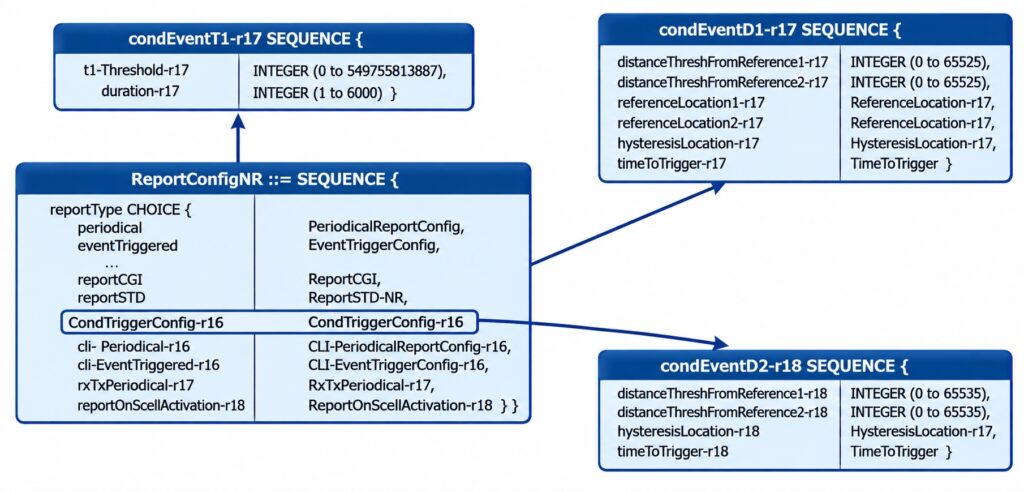
Conventional Measurement Events
Before discussing NTN-specific events, it is useful to understand the conventional measurement events like A3, A4 and A5 used for mobility.
- Event A3 – Neighbor Becomes Better Than Serving Cell: Event A3 is triggered when the measured quality of a neighboring cell becomes better than the serving cell by a configured offset. e.g., when a UE is connected to a NTN cell and another satellite cell provides better radio conditions, the network can use Event A3 to sent measurement reporting. The UE evaluates the difference between serving and neighboring cell measurements, considering configured offsets and hysteresis. A typical use case of this event is for relative radio signal based mobility between serving and neighboring cells.
- Event A4 – Neighbor Becomes Better Than Absolute Threshold: Event A4 is triggered when the measurement result of a neighbouring cell becomes better than a configured absolute threshold. For example, a UE connected through Satellite 1 may detect Satellite 2. When the signal quality of Satellite 2 exceeds the configured threshold, Event A4 can trigger a measurement report. Unlike A3, Event A4 does not require the neighbouring cell to be better than the serving cell. Typical use: Identifying a suitable neighbouring satellite cell based on an absolute radio-quality threshold.
- Event A5 – Serving Cell Becomes Worse and Neighbor Becomes Better: Event A5 uses two measurement thresholds. It is triggered when both conditions are satisfied:
- The serving cell becomes worse than Threshold 1
- The neighbouring cell becomes better than Threshold 2
e.g. if the serving satellite’s signal quality deteriorates while another satellite provides acceptable radio conditions, Event A5 can trigger measurement reporting. It is used for mobility when the serving cell quality is deteriorating and a suitable target cell is available.
These conventional events are important for NTN because radio signal based mobility remains relevant even when additional location and time based events are introduced.
NTN Specific Measurement and Conditional Events
3GPP Release 17 introduced additional NTN mobility capabilities through location-based and time-based conditional handover triggers. These events help the UE evaluate mobility conditions using information beyond conventional radio measurements.
- Event D1: Introduced in 3GPP Release 17, It uses UE distance from two reference locations
- Event T1: This one also introduced in 3GPP Release 17, It consider the absolute time and configured duration
- Event D2: This event is introduced in 3GPP Release 18, Distance involving a moving satellite reference location.
Event D1 – Distance-Based Conditional Handover
Event D1 is a location based event introduced in 3GPP Release 17. It considers the geographical distance between the UE and two configured reference locations, instead of only RSRP or RSRQ. The network configures the parameters like
- distanceThreshFromReference1
- distanceThreshFromReference2
- referenceLocation1
- referenceLocation2
- hysteresisLocation
- timeToTrigger
The two reference locations represent the serving cell reference location and the candidate target cell reference location as shown in following figure.
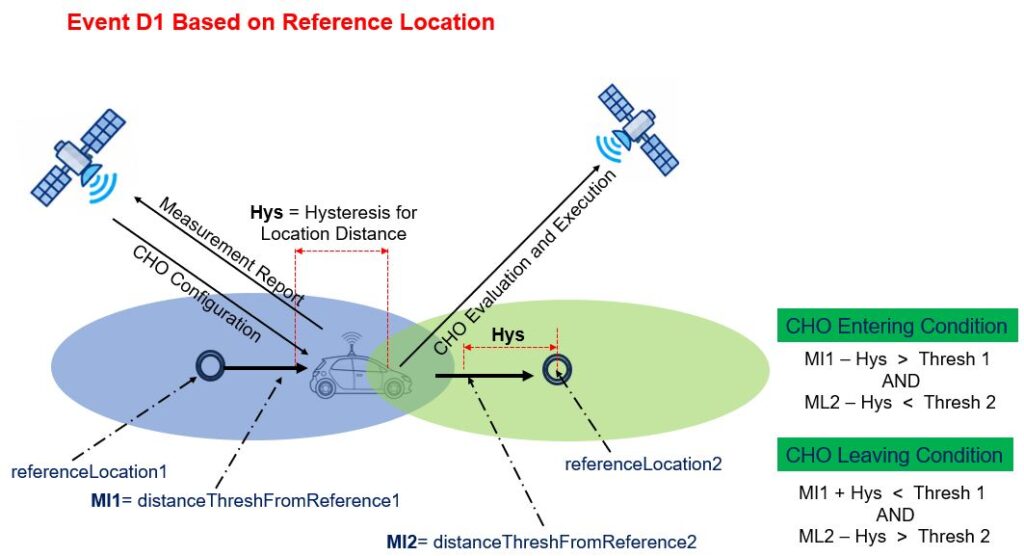
Event D1 entering conditions
The UE evaluates two conditions:
- Distance between the UE and Reference Location 1 becomes greater than the configured distance threshold 1.
- Distance between the UE and Reference Location 2 becomes smaller than the configured distance threshold 2.
Both conditions must be fulfilled for the configured Time To Trigger (TTT).
- Event D1 Scenario: Consider a UE moving through an NTN coverage area. Initially, the UE is closer to the reference location of Satellite 1. As it moves towards the coverage area associated with Satellite 2, its distance from the first reference location increases while its distance from the second reference location decreases. Once both configured distance conditions are satisfied, the UE considers the D1 event fulfilled. This allows the UE to execute a previously configured conditional handover without waiting for the serving satellite signal to become very weak.
Event D1 Usecase
- Supports location aware satellite mobility
- Helps prepare handover before the serving satellite coverage becomes unreliable
- Reduces dependence on radio signal quality alone
- Supports predictable mobility
Event T1 – Time-Based Conditional Handover
Event T1 is another NTN-specific conditional handover trigger introduced in Release 17. Unlike D1, which depends on UE geographical position, T1 uses an absolute time reference. The network configures two important parameters:
- t1-Threshold-r17
- duration-r17
The t1-Threshold represents an absolute UTC time encoded in 10 ms units.
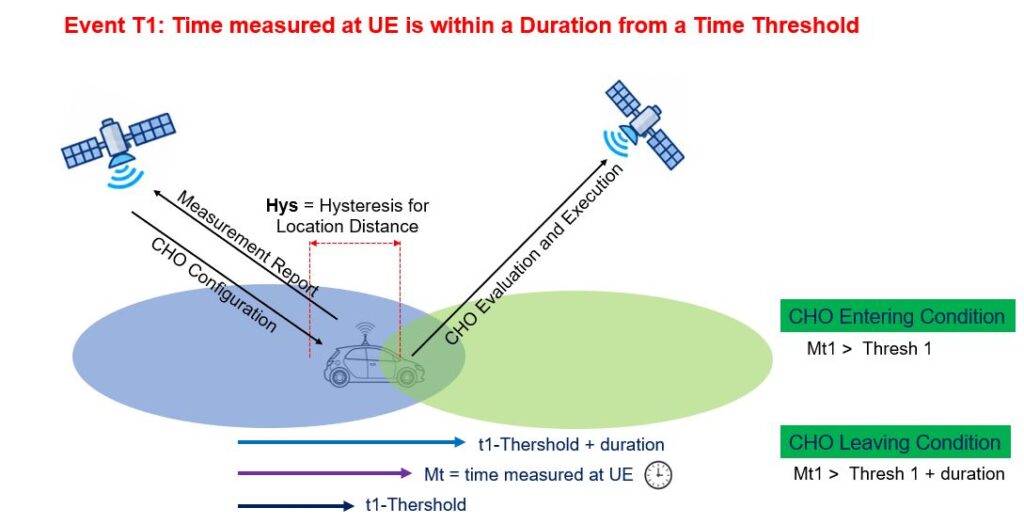
How does Event T1 work?
The UE evaluates the configured absolute time threshold. When the configured entry condition is fulfilled, the T1 event becomes satisfied and the corresponding conditional reconfiguration can be executed. The duration parameter defines the leaving condition, referred to as T1-2.
- Event T1 scenario: Consider a satellite providing coverage to a particular geographical area for a limited period. The network knows when the current satellite is expected to stop serving that area. It can configure a conditional handover for a target satellite before the serving satellite’s coverage period ends. The UE can use the configured time condition to execute the handover at the appropriate time.
How is Event T1 useful?
- Supports time predictable satellite mobility.
- Helps prepare handover before satellite service termination.
- Reduces dependence on last-moment radio measurements.
- Supports satellite service transitions where coverage timing is known in advance.
Event D2 – Moving Reference Location Based
Event D2 was introduced in Release 18 to enhance location-based mobility, particularly for NTN Earth-moving cell scenarios. Event D1 uses two configured reference locations. However, when satellite cells move relative to the Earth, a fixed reference location may not adequately represent the changing geographical relationship between the satellite and the UE. Event D2 addresses this by introducing a moving reference location.
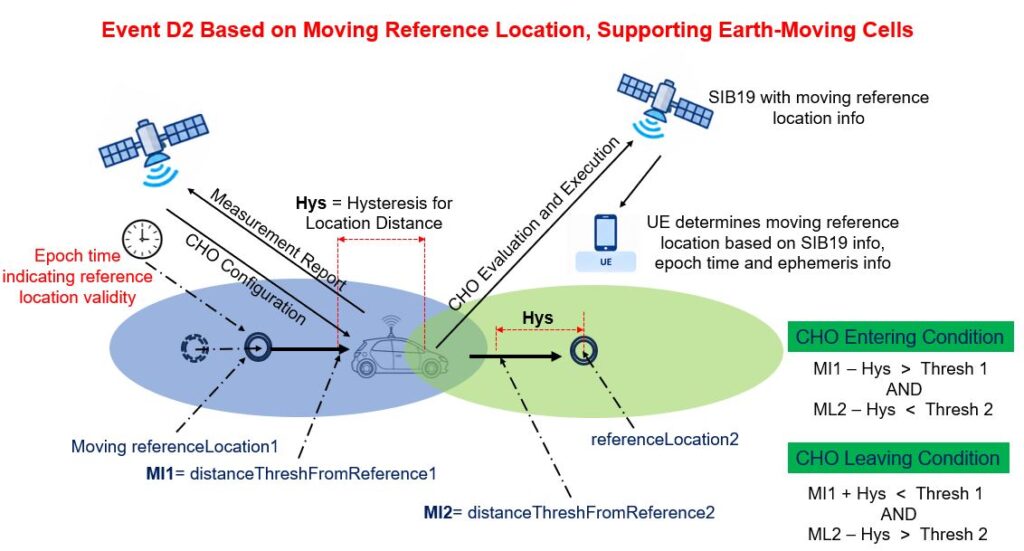
The UE uses the serving satellite’s moving reference location, satellite ephemeris and epoch time information to determine the relevant distance. The required satellite assistance information is provided through SIB19. The important configuration parameters include:
- distanceThreshFromReference1-r18
- distanceThreshFromReference2-r18
- referenceLocation2-r18
- hysteresisLocation-r18
- timeToTrigger-r18
How does Event D2 work?
For the Event D2 to work UE evaluates following:
- Distance from the moving reference location associated with the serving satellite
- Distance from Reference Location 2 associated with the candidate target cell
The first distance must become greater than the configured Threshold 1, while the second distance must become smaller than Threshold 2. Both conditions must remain satisfied for the configured Time To Trigger.
D2 Scenario Example
Consider a LEO satellite in an Earth-moving cell configuration. As the satellite moves along its orbit, its geographical reference location changes with time. The UE receives the required satellite assistance information, including the moving reference location, ephemeris and epoch time via the NTN SIB#19 .
Using this information, the UE evaluates its distance relative to the moving serving cell reference location and the configured target cell reference location. When both distance conditions are satisfied for the configured duration, the D2 event is fulfilled.
This enables mobility decisions to account for satellite movement rather than relying entirely on static geographical reference locations.
Why is Event D2 useful?
- Supports mobility in Earth-moving satellite cell scenarios.
- Accounts for satellite movement using ephemeris information.
- Improves location-based handover preparation.
- Provides a more suitable reference for satellite mobility than relying only on fixed locations.
Role of SIB19 in NTN Measurement Events
SIB19 plays an important role in NTN. It provides satellite assistance information required by the UE to access and operate in NTN networks. Depending on the configuration and release, SIB19 can provide information like NTN configuration information, Satellite ephemeris information, Epoch time, Serving-cell reference location, Distance threshold information, NTN neighboring cell configuration and Moving reference location.
For location based mobility, the UE uses the available location and satellite assistance information to evaluate the configured measurement conditions. In particular, movingReferenceLocation parameter supports the evaluation of Event D2 and conditional Event D2 in the Release 18. This makes SIB19 an important part of the NTN mobility framework.
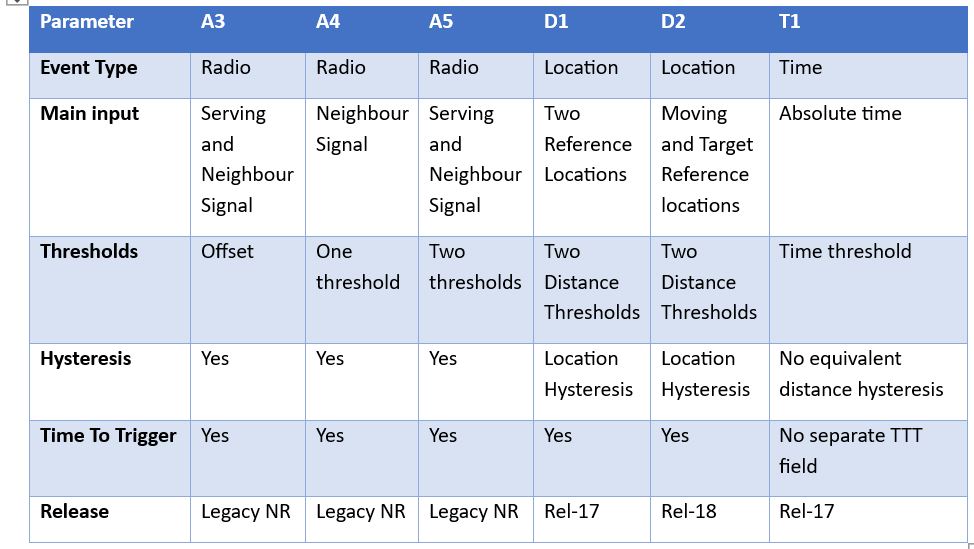
Comparison of NTN Measurement Events
The following table summarizes the main differences between conventional radio signal based events and NTN Specific Events.
How NTN Measurement Events Support Conditional Handover
Conditional Handover (CHO) allows the network to prepare a handover configuration in advance and let the UE execute it when the configured conditions are fulfilled. In NTN, this is particularly useful because satellite mobility is predictable to some extent using satellite position, ephemeris and service timing information. A simplified procedure is as follows:
- Step 1 – Measurement Configuration: The gNodeB configures measurement objects and reporting or conditional reconfiguration conditions through RRC signaling.
- Step 2 – Conditional Handover Preparation: The network prepares one or more candidate target-cell configurations and sends them to the UE using RRCReconfiguration.
- Step 3 – UE Evaluates Trigger Conditions: The UE evaluates the configured conditions using radio measurements, geographical location or time information.
- Step 4 – Conditional Event Fulfilment: When all required conditions for the configured candidate cell are fulfilled, the UE considers that candidate cell triggered.
- Step 5 – Handover Execution: The UE applies the stored conditional reconfiguration and performs the corresponding mobility procedure.
This approach helps reduce dependence on real-time handover commands when satellite coverage transitions can be predicted in advance.
Important Considerations for NTN Protocol Testing
For protocol test engineers, NTN measurement events introduce several important test scenarios. The following test cases are useful when validating NTN mobility procedures.
- Event D1 distance threshold validation
- Configure two reference locations.
- Verify the UE distance calculations.
- Check that both distance conditions are fulfilled.
- Verify that the configured Time To Trigger is respected.
- Event T1 time threshold validation
- Configure an absolute time threshold.
- Verify event entry at the configured time.
- Check the duration-based leaving condition.
- Verify conditional handover execution.
- Event D2 moving reference location validation
- Configure the moving reference location through NTN system information.
- Provide satellite ephemeris and epoch time.
- Verify UE distance evaluation against the moving reference location.
- Check the target reference location condition.
- Hysteresis and Time To Trigger validation
- Verify that distance fluctuations do not result in premature event triggering.
- Check the entering and leaving conditions.
- Validate the effect of hysteresis and Time To Trigger.
- SIB19 information validation
- Verify the correct acquisition of NTN assistance information.
- Check ephemeris and epoch time handling.
- Verify reference location and moving reference location processing.
- Conditional handover execution
- Configure a candidate target cell.
- Verify that the UE stores the conditional configuration.
- Trigger the configured event.
- Validate the execution of the stored reconfiguration.
These test cases can help to validate the UE’s implementation of NTN mobility and the interaction between RRC configuration, location information and satellite assistance data.
Conclusion
5G NR NTN introduces additional mobility requirements because satellite movement, geographical coverage and service availability cannot always be handled efficiently using conventional radio measurement events alone.
While A3, A4 and A5 continue to support radio-quality-based mobility, Release 17 introduced D1 and T1 to support location-based and time-based conditional handover. Release 18 further enhanced location-based mobility through D2, which uses a moving reference location and satellite assistance information.
Together, these mechanisms provide a more flexible mobility framework for satellite networks.
Related Post
- Satellite Ephemeris in 5G NTN
- System Information 19 – SIB19 For 5g Satellite NTN
- NTN Call Flow Tutorial
- Handover in Non-Terrestrial Networks
- Conditional handover (CHO)
References
- 3GPP TS 38.331 – NR; Radio Resource Control (RRC); Protocol Specification, particularly the ReportConfigNR and CondTriggerConfig definitions. ETSI TS 38.331 Release 18.
- 3GPP TS 38.300 – NR and NG-RAN Overall Description, particularly clause 16.14 covering NTN mobility. ETSI TS 38.300 Release 17.
- Rohde & Schwarz – 5G NTN Takes Flight: A Deep Dive into NR-NTN Technology and Testing Aspects, Section 6.6.2. Read the technical white paper.