
NTN Call Flow Tutorial: RRC, NAS, RACH and PDU Session
5G NR NTN extended the connectivity beyond traditional cellular infrastructure by using satellites or other airborne platforms as part of the RAN Network.
For a System Engineer/Protocol Engineer, however, NTN is not simply “5G NR with a satellite in the middle.”
The fundamental NR procedures remain similar e.g. Cell search, System Information acquisition, random access, RRC establishment, NAS registration and PDU session establishment, but the timing model, mobility behavior, synchronization, propagation delay and network architecture introduce additional challenges and requires modification in the protocol stack.
NTN Architecture Behind the Call Flow
Before looking at messages, lets establish the understanding with NTN architecture. A simplified NR NTN deployment is illustrated in following diagram includes a UE, Satellite Payload in defined orbit, gNodeB acting as Satellite Gateway at ground and 5G Core Network.
3GPP has defined following two types of satellite payloads, the exact architecture depends on the NTN deployment.
- Transparent payload: In a transparent payload architecture, the satellite essentially provides the radio relay function. The gNB remains on the ground.
- Regenerative payload: In a regenerative architecture, some or all NG-RAN functionality can be located on the satellite.
The understanding the payload type is very important, because it can affect propagation-delay distribution, gNB location, N2 connectivity, mobility behavior, user-plane routing,timing assumptions.
3GPP is continuing to enhance the architecture for regenerative satellite access, particularly in Release 19.
Practical NTN Call Flow
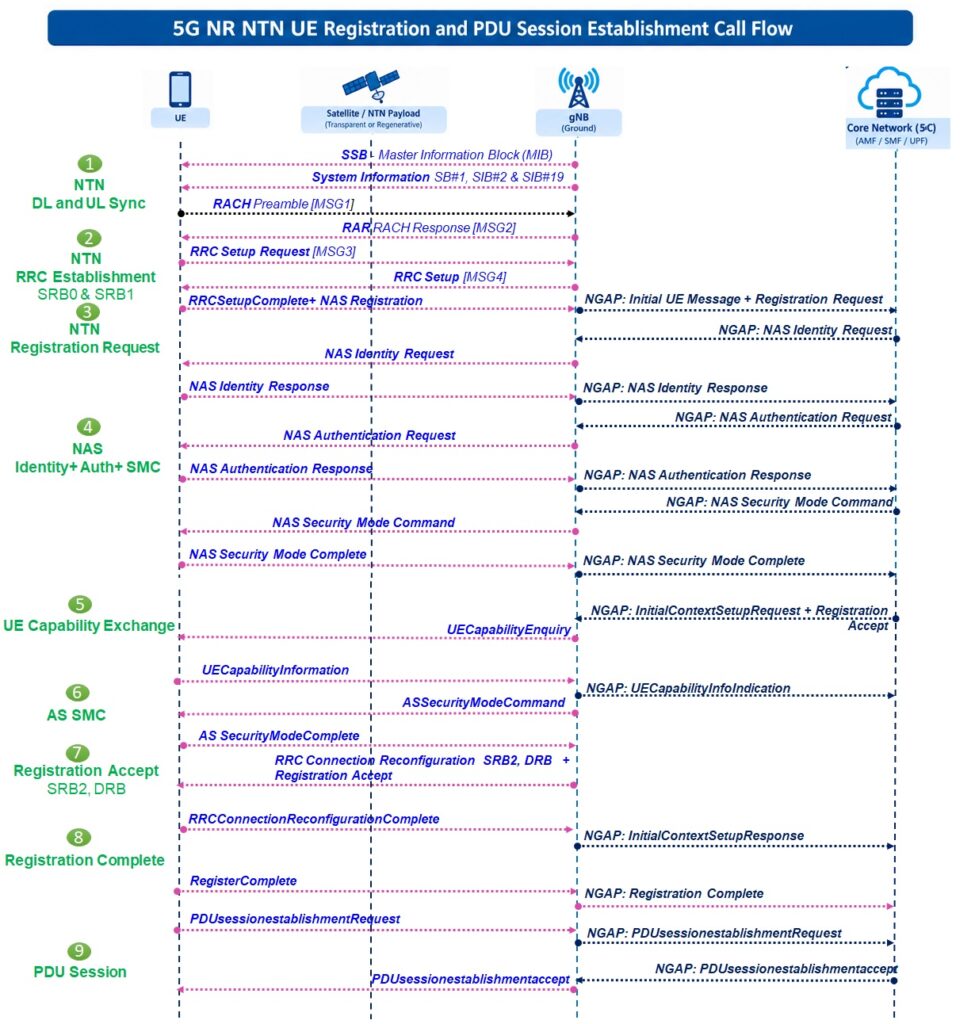
The following Call flow shows the complete E2E procedure from NTN System Information acquisition and random access, 5GS registration, NAS and AS security activation, UE Capability Exchange, and Establishment of an operational PDU session for data transfer.
NTN DL and UL Synchronization
NTN DL Synchronization includes the successful decode of NTN Cell SSB information which provide PCI and MIB information to the UE. After Successfull decode of SSB UE can move further to decode System Information like SIB1,SIB2 and SIB19 .
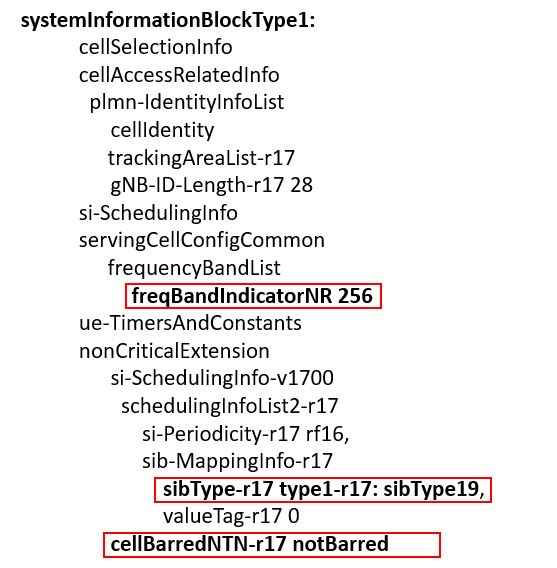
SIB#1 provides NTN Cell access. NTN related information within SIB#1 like freqBandIndicatorNR e.g 256, and cellBarredNTN i.e. NTN cell Barring status which is set to be notBarred, indicating that NTN cell is allowed for UE access. SIB#1 further provides scheduling information of additional brodcasted SIBs.
SIB#19 supplies the common TA and drift, orbital ephemeris, cell-specific K offset, service time, and TA-report enablement.
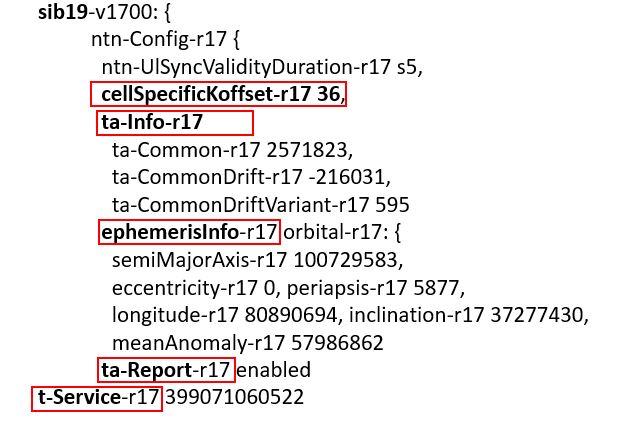
- cellSpecificKoffset-r17 extends scheduling timing to account for the long NTN propagation delay
- ta-info provide common timing advance, drift, and drift-variation values give the UE the cell-level timing model
- orbital ephemeris lets a location-aware UE estimate satellite motion and perform uplink timing/frequency pre-compensation
- ta-Report indicates that UE timing-advance reporting is enabled for this cell
After applying the NTN assistance information, the UE transmits a PRACH preamble. The gNB responds with a Random Access Response, including the uplink grant and timing adjustment. The UE then sends RRCSetupRequest in Msg3 and receives RRCSetup in Msg4.
NTN RRC Establishment
Registration Request
NAS Idendity + Authentication and Security Mode
UE Capability Exchange
AS Security Mode
Registration Accept and Registration Complete
NTN PDU Session
References
- 3GPP TS 38.331 – NR Radio Resource Control protocol.
- 3GPP TS 38.321 – NR Medium Access Control protocol.
- 3GPP TS 24.501 – 5GS NAS protocol.
- 3GPP TS 38.413 – NG-RAN NGAP protocol.