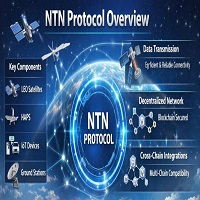
Chipsets Supporting NTN: Enabling Satellite Connectivity
Introduction
NTN Networks are taking global communication to new heights by enabling devices to connect directly to satellites, ensuring connectivity availability even in the most remote locations. With 3GPP Release 17 and Release 18 standardization, chipset manufacturers like Qualcomm, MediaTek, Sony and Samsung Electronics etc. are rapidly innovating to support satellite based communication across variety of device like smartphones, IoT devices, vehicles, and wearables.
At the core of design and innovation of these advanced chipsets, there are the unique challenges of satellite communication are handled related to latency, doppler shift, and low signal strength.
Why NTN Chipsets Matter
NTN chipsets shows a fundamental shift in how devices connect to telecommunication infrastructure. Unlike traditional cellular chipsets Which rely only on terrestrial base stations, NTN powered chipsets are designed to communicate directly with satellites, providing connectivity in areas where traditional networks are unavailable or unreliable.
With evolving 3GPP standards, these chipsets incorporate advanced capabilities like enhanced link budgets, Doppler compensation, and efficient power management. This makes chipset supporting mission critical operations, and enabling seamless global communication across industries like aviation, maritime, defense, and remote IoT deployments.
Key Advantages of NTN Chipsets
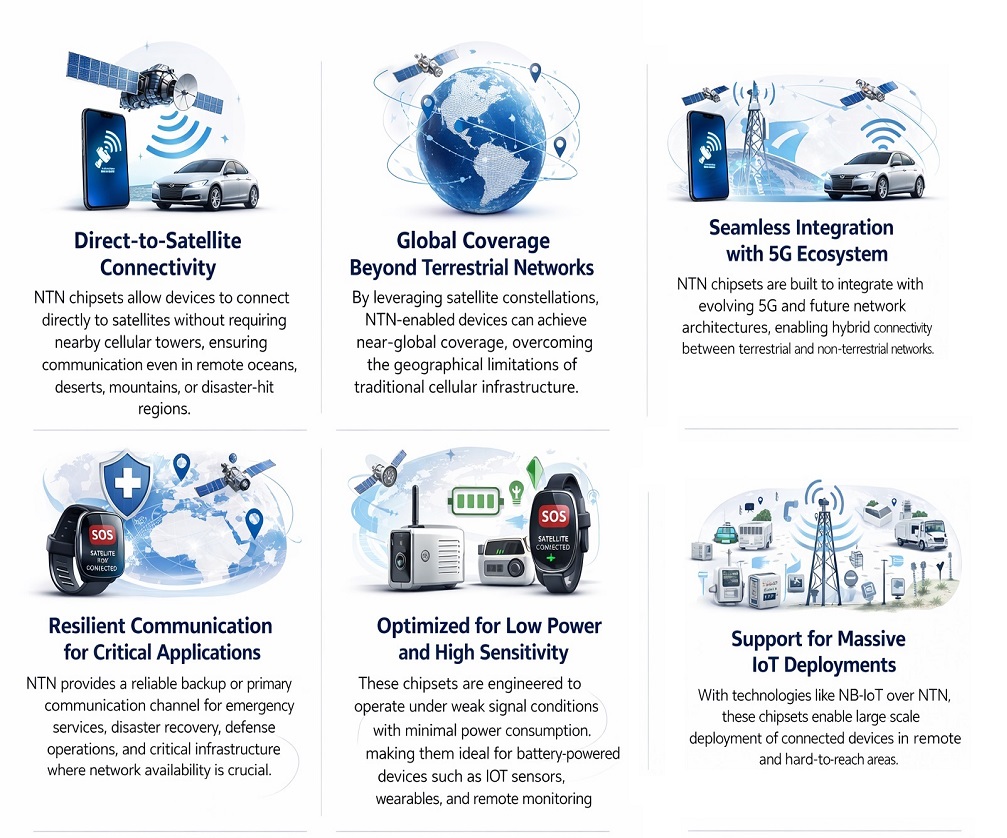
- Direct to Satellite Connectivity: NTN chipsets allow devices to connect directly to satellites without requiring nearby cellular towers, ensuring communication even in remote oceans, deserts, mountains, or disaster-hit regions.
- Global Coverage Beyond Terrestrial Networks: By leveraging satellite constellations, NTN-enabled devices can achieve near global coverage across borders, overcoming the geographical limitations of traditional cellular infrastructure.
- Resilient Communication for Critical Applications: NTN provides a reliable backup or primary communication channel for emergency services, disaster recovery, defense operations, and critical infrastructure where network availability is crucial.
- Optimized for Low Power and High Sensitivity: These chipsets are engineered to operate under weak signal conditions with minimal power consumption, making them ideal for battery-powered devices such as IoT sensors, wearables, and remote monitoring systems.
- Seamless Integration with 5G Ecosystem: NTN chipsets are built to integrate with evolving 5G and future network architectures, enabling hybrid connectivity between terrestrial and non-terrestrial networks.
- Support for Massive IoT Deployments: With technologies like NB-IoT over NTN, these chipsets enable large-scale deployment of connected devices in remote and hard-to-reach areas.
Leading Chipsets Supporting NTN
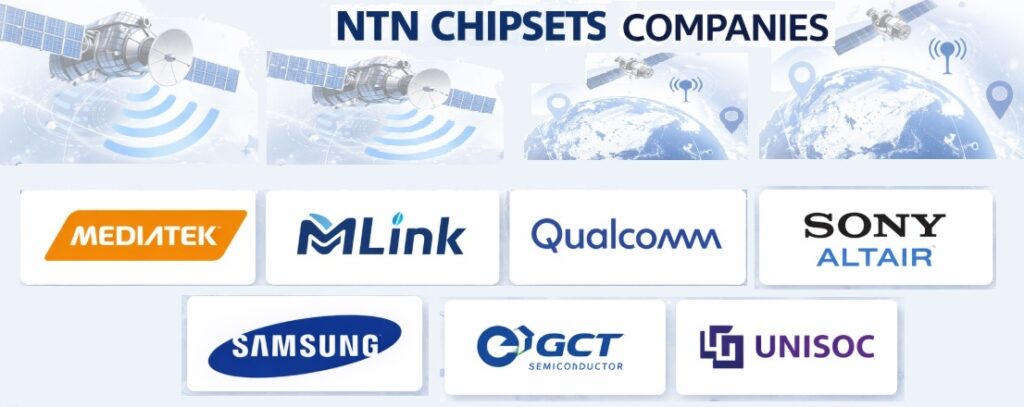
The key industry players driving the evolution of NTN chipset technology, includes companies like MediaTek, Qualcomm, Samsung Electronics, and others. These companies are at the forefront of enabling direct to satellite connectivity, powering the next generation of global communication beyond traditional networks. Their NTN solutions are listed below.
MediaTek NTN Chipsets
MediaTek is aggressively pushing NTN for both IoT and 5G devices.
- MediaTek MT6825: This chipset from MediaTek is highly integrated and power-efficient designed for IoT-NTN, enabling global satellite coverage for mobile applications.
- M90 5G Modem: It is an advanced 5G modem compliant with 3GPP Release 17 and aligned with Release 18 (5G Advanced), targeting high-performance eMBB and NTN integration.
MLink NTN Solutions
MLink focuses on flexible and software-defined NTN architectures.
- MS210: This modem chip supports R17 IoT NTN (L-band N255 / S-band N256 / B23) having integrated baseband, RF transceiver, and PMIC. RX sensitivity up to -128 dB, Supports voice and data and compact QFN (6mm × 6mm)
- MS150: It is a Multi-mode satellite communication via SDR platform, supports L & S bands integrated DSP, RF, and baseband, inbuilt voice encoder and supports multiple modulation techniques and channel encoding and decoding formats
Qualcomm NTN Ecosystem
Qualcomm offers one of the most comprehensive NTN portfolios across IoT, mobile, automotive, and wearables.
IoT & Industrial
- Qualcomm 212S: Designed for off-grid, stationary IoT sensing and monitoring applications.
- Qualcomm MDM9205S: Enables seamless switching between terrestrial cellular and satellite networks for IoT deployments.
5G & Advanced Modems
- X80 5G Modem-RF: High-performance modem enabling next-gen connectivity with NTN integration capabilities.
- X85 5G Modem-RF: AI-powered modem with advanced spectrum flexibility and 5G Advanced readiness.
Smartphone Platforms
- Snapdragon® 8 Elite Gen 4: This Mobile Platform is High-performance platform with AI-driven enhancements and advanced connectivity features.
- Snapdragon® 8 Elite Gen 5: This Mobile Platform is Next-gen platform powered by Oryon CPU, enabling AI-driven applications and advanced satellite connectivity.
Automotive NTN Solutions
- Snapdragon® Auto 5G GEN 2 – SA522M : This is an entry Level Snapdragon® Auto 5G Gen 2 Modem-RF solution featuring high performance processing power and 5G connectivity to provide enhanced safety, network coverage and a reliable connectivity experience. It’s an automotive grade solution that supports 3GPP R17 NB-NTN satellite communication to ensure connectivity is ubiquitously available.
- Snapdragon® Auto 5G GEN 2 – SA525M : This is a premium tier Snapdragon® Auto 5G Gen 2 Modem-RF solution features high performance processing power and up to 200 MHz of network capacity to support reliable, low-latency connectivity for enhanced safety and more intelligent and immersive riding experiences. This reliable automotive grade solution supports 3GPP R17 NB-NTN satellite communication to ensure connectivity is ubiquitously available.
Wearable Platforms
- Snapdragon® W5+ Gen 2: This platform is the world’s first platform designed for wearables to support NB-NTN for sending and receiving emergency messages via satellite outside of cellular and Wi-Fi coverage areas. Machine learning capabilities along with an optimized RFFE help to deliver more accurate location tracking, greater power efficiency and a smaller package size for smaller device designs
- Snapdragon® Wear Elite: The Wear Elite platform delivers advanced on-device AI, high performance, low power consumption and robust connectivity including 5G Redcap and NB-NTN empowering the personal AI ecosystem with smarter, more secure and personalized experiences.
Samsung NTN Chipsets
Samsung Electronics is integrating NTN into mainstream consumer devices with following chipsets.
- Exynos 2500: It is built for speed and designed for everywhere. The new Exynos 2500 comes equipped with a 5G NR modem that supports the latest 3GPP standards, ensuring smooth and powerful connectivity for everyday use. The Exynos 2500 enables satellite-based emergency calls and even SMS in areas beyond cellular coverage.
- Exynos Modem 5400: This chip is providing incredibly fast data transfers and rapid data processing, Exynos Modems deliver elevated performance with improved power efficiency and smaller chip sizes. Ultra-fast connectivity empowers new 5G experiences.
- Exynos Modem 5410: The Exynos Modem 5410 integrates satellite communication technologies on a single chip to provide reliable connectivity, even in remote areas. It enjoy reliable connectivity, wherever you are.
Sony Altair IoT NTN Chipsets
Sony Semiconductor Solutions offers optimized solutions for IoT.
- Sony-Altair ALT1250: Dual-mode LTE-M / NB-IoT modem with 2G fallback, designed for low power consumption and compact IoT deployments.
GCT Semiconductor
GCT Semiconductor provides flexible NTN-enabled LTE chips.
- GDM7243SL: Supports NTN and multiple LTE modes, Single-chip solution with RF + modem Switchable between NTN, NB-IoT, Cat-M, Cat-1, and Cat-4
Unisoc NTN Chipsets
Unisoc is targeting mass-market NTN adoption.
- UIS8821: Supports Release 17 NB-NTN, Enables two-way voice and data Suitable for smartphones, wearables, IoT, and automotive applications, Low power and compact design
Related Posts
- 5G Non-Terrestrial Network Terminologies
- NB-IoT NTN vs. 5G NR NTN: Key Differences and Use Cases
- 3GPP NTN Use Case Categories: Service Continuity, Ubiquity, Scalability
- The Future and Opportunities of Non-Terrestrial Networks (NTNs)
- 3GPP Frequency Bands for 5G Satellite Communication
- NTN RACH Procedure Impacts – NTN RACH
- System Information 19 – SIB19 For 5g Satellite NTN
- 5G NTN Quality of Service – 5G NTN QoS