Handover in Non-Terrestrial Networks
Introduction NTN Handover
5G is evolving toward global connectivity, Non-Terrestrial Networks (NTN) have become a key enabler for extending mobile services beyond the reach of traditional terrestrial infrastructure. By utilizing the satellites particularly Low Earth Orbit (LEO) constellations and high-altitude platforms, NTN promises to deliver coverage in remote, rural, and maritime regions where deploying conventional ground BTS is impractical or economically unfeasible.
The most critical challenge in NTN integration is handover (HO), is to allows a user device (UE) to maintain an ongoing session while moving across different cells, satellites, or between terrestrial and non-terrestrial domains. Unlike traditional terrestrial handover, NTN handover is complicated by continuous satellite movement, larger propagation delays, Doppler effects, and frequent service beam changes. These characteristics requires new approaches to mobility management within the NTN RAN and Core.
In this, article we will explore,
- How NTN handover works?
- why it fundamentally differs from terrestrial scenarios?
- and what technical solutions are emerging to ensure seamless NTN mobility?
Why Handover is Different in NTN
In conventional terrestrial mobile networks, handover mainly happens due to the UE movement from one cell coverage area to another cell while base stations are stationary. However in NTN systems, handover behavior is fundamentally different because the satellite (base station) itself is moving relative to the Earth i.e. both UE as well as base station are moving at different speeds.
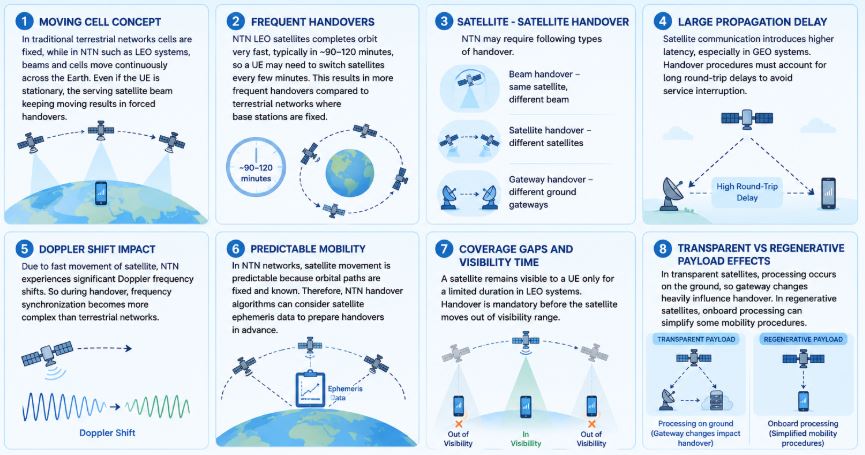
Key reasons why handover is different in NTN:
- Moving Cell Concept: In traditional terrestrial n/w cells are fixed, while in NTN such as LEO systems, beams and cells move continuously across the Earth. Even if the UE is stationary, the serving satellite beam keeping moving results in forced handovers.
- Frequent Handovers: NTN LEO satellites completes orbit very fast, typically in ~90–120 minutes, so a UE may need to switch satellites every few minutes. This results in more frequent handovers compared to terrestrial n/w where base stations are fixed.
- Satellite – Satellite Handover: NTN may require following types of handover.
- Beam handover – same satellite, different beam
- Satellite handover – different satellites
- Gateway handover – different ground gateways
- Large Propagation Delay: Satellite communication introduces higher latency, especially in GEO systems. Handover procedures must account for long round-trip delays to avoid service interruption.
- Doppler Shift Impact: Due to fast movement of satellite, NTN experiences significant Doppler frequency shifts. So during handover, frequency synchronization becomes more complex than terrestrial networks.
- Predictable Mobility: In NTN n/w, satellite movement is predictable because orbital paths are fixed and known. Therefore, NTN handover algorithms can consider satellite ephemeris data to prepare handovers in advance.
- Coverage Gaps and Visibility Time: A satellite remains visible to a UE only for a limited duration in LEO systems. Handover is mandatory before the satellite moves out of visibility range.
- Transparent vs Regenerative Payload Effects: In transparent satellites, processing occurs on the ground, so gateway changes heavily influence handover. In regenerative satellites, onboard processing can simplify some mobility procedures.
Types of NTN Handover
In NTN n/w, handover can happen at different levels depending on the network topology and UE movement to ensure seamless mobility without causing call session drop. The major categories are:
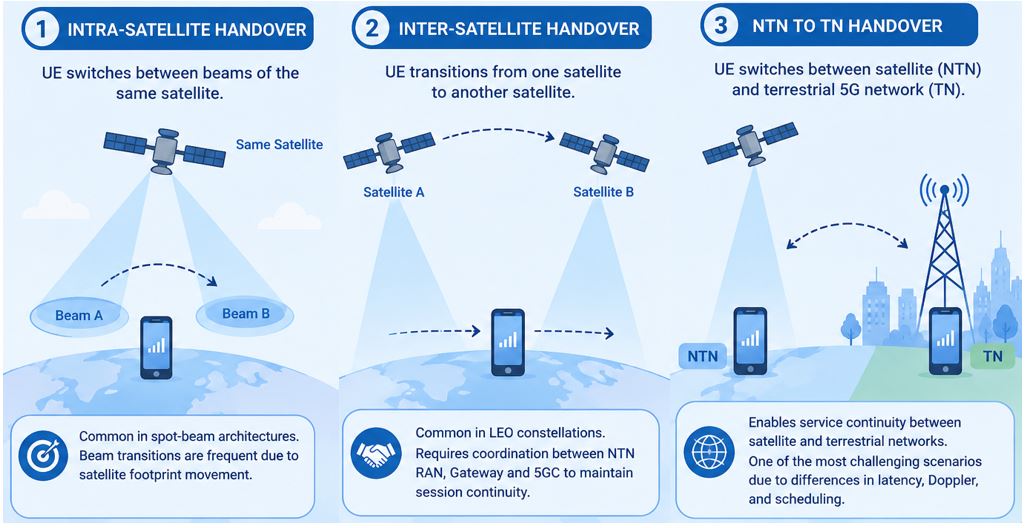
- Intra-Satellite Handover: Occurs when UE switches between beams of the same satellite. Common in spot-beam architectures, where a single satellite projects multiple coverage areas to increase capacity. Like handovers in terrestrial networks, beam transitions are often more frequent due to satellite footprint movement.
- Inter-Satellite Handover: Happens when the UE transitions from one satellite to another. Particularly frequent in LEO constellations, where satellites have fast-moving orbits and limited visibility duration. Coordinating between the NTN gateway, 5GC, and the Radio Access Network (RAN) is required to maintain session continuity.
- NTN to TN Handover: A UE may move between terrestrial 5G and NTN coverage in hybrid deployments. This handover ensures service continuity when users travel from urban areas (dense terrestrial cells) to remote regions (served by satellites)—often considered one of the most challenging scenarios because of significant differences in latency, Doppler, and scheduling strategies.
Conditional Handover in NTN
Conditional Handover also short known as CHO is highly suitable because NTN based systems experience fast moving beams, frequent handovers, and large propagation delays. In LEO NTN systems, satellites continuously move relative to the Earth, requiring UE to switch beams or satellites within short time intervals.
Unlike traditional handover mechanisms that rely on real-time signaling, CHO prepares target handover configurations in advance and allows the UE to execute the handover automatically when predefined conditions are met. This significantly reduces handover latency, signaling overhead, and service interruption.
CHO is particularly effective in NTN because satellite movement is predictable using orbital and ephemeris data, enabling proactive mobility management. It also improves handover reliability, minimizes radio link failures, and supports seamless connectivity for delay sensitive services such as voice, video streaming, and IoT communications across satellite and hybrid terrestrial-satellite networks.
Detailed CHO Call flow is shown here.
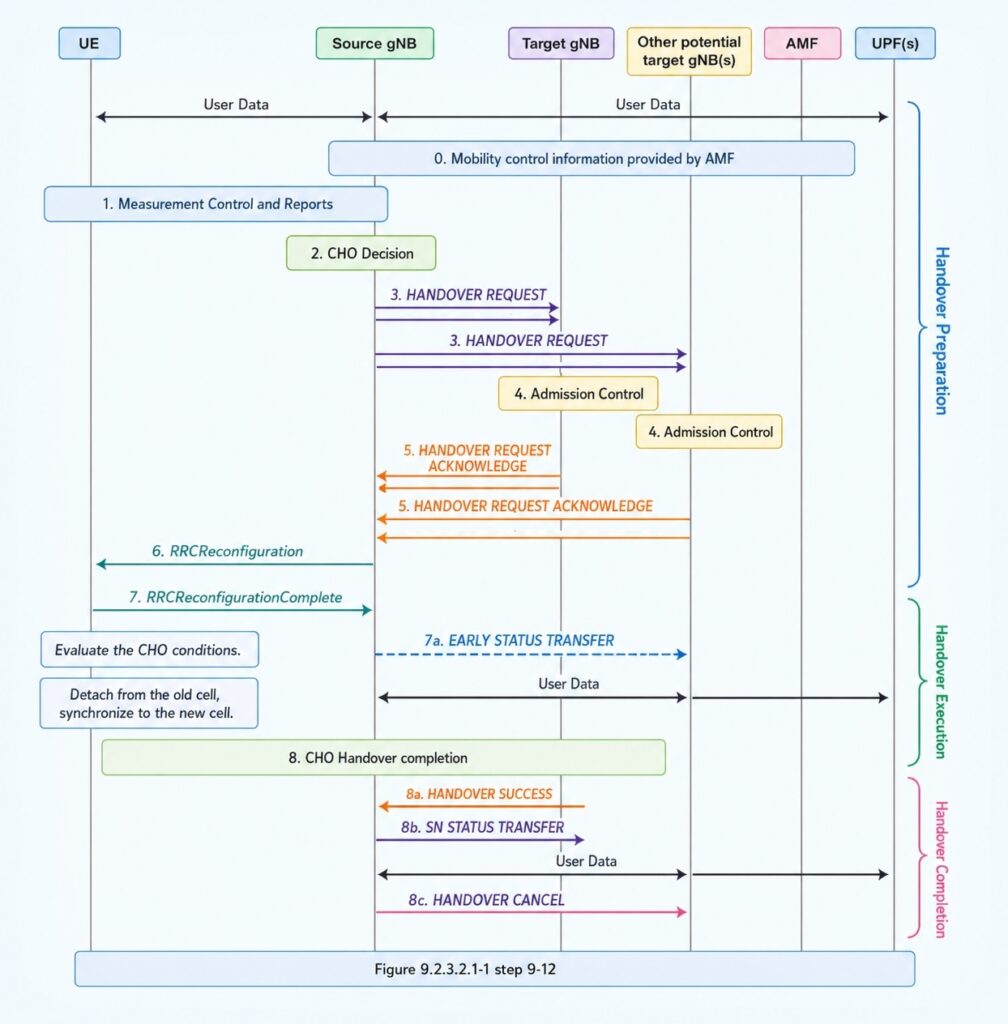
- Step 2: The source gNB requests CHO for one or more candidate cells belonging to one or more candidate gNBs.
- Step 3-4: A CHO request message is sent for each candidate cell. Candidate gNBs provide CHO responses with configurations of possible target cells.
- Step 5: The source gNB delivers these candidate cell configurations and execution conditions to the UE.
- Step 6: The UE acknowledges and stores them while staying connected to the source gNB.
- Step 7a-8: When one of the candidate cells meets the CHO condition, the UE independently detaches from the source gNB and completes handover to the selected target gNB.
Any unused candidate configurations are discarded once the handover is successful.
Role of 5G Core in NTN Handover
5G Core is responsible for control plane and user plane function to support CHO in NTN system. From the control plane perspective, NTN handover is primarily orchestrated by the 5G Core:
- AMF (Access and Mobility Management Function)
- Manages UE registration, context transfer, and mobility events.
- Handles signaling for HO requests and target cell selection.
- SMF (Session Management Function)
- Ensures session continuity by managing PDU session contexts during path switches.
- Coordinates with the UPF to redirect data flows post-handover.
- NG-RAN Integration
- gNBs (or TNGF for satellite access) report measurement events and initiate HO procedures.
- Control-plane signaling is adapted to cope with higher delays and Doppler effects.
The key challenge is ensuring UE context transfer happens fast enough to prevent session drops despite long propagation delays. On the data plane, the UPF plays a crucial role in maintaining uninterrupted user traffic flow:
- Path Switch Procedure: When the serving gNB changes (e.g., due to inter-satellite HO), the UPF must update its forwarding path.
- Session Anchoring: New UPFs may be selected to optimize latency or resource use.
- Latency Considerations: With satellite backhaul, rerouting packets through different gateways introduces additional delay. Efficient path switching is essential to minimize service interruption.
Conclusion
NTN handover is much more complex than a extension of traditional terrestrial network handover procedures, as it introduces unique challenges associated with moving satellites, large propagation delays, Doppler effects, and frequent beam or satellite transitions.
In LEO systems, even stationary users may require continuous handover due to the dynamic movement of satellite footprints across the Earth. So handover mobility management in NTN must be highly adaptive and intelligent to maintain seamless connectivity and global service continuity.
Technology is evolving with advanced mobility solutions such as predictive handover algorithms, AI-driven network optimization, conditional handover mechanisms, smarter session anchoring, and multi-connectivity techniques will play a critical role in improving NTN reliability and performance.
As 5G evolves toward 6G, seamless integration between terrestrial and non-terrestrial networks will become a key enabler for truly ubiquitous, always-connected global communication.