
5G Non-Terrestrial Network Terminologies
5G evolution expanded far beyond traditional terrestrial cellular networks. Current major deployments providing deep urban and suburban coverage, but a large portions of the globe which includes oceans, deserts, mountains, and remote rural areas remain unconnected. To overcome this limitation, 3GPP introduced Non-Terrestrial Networks (NTN) as part of its standardization roadmap, enabling 5G connectivity via satellites and airborne platforms.
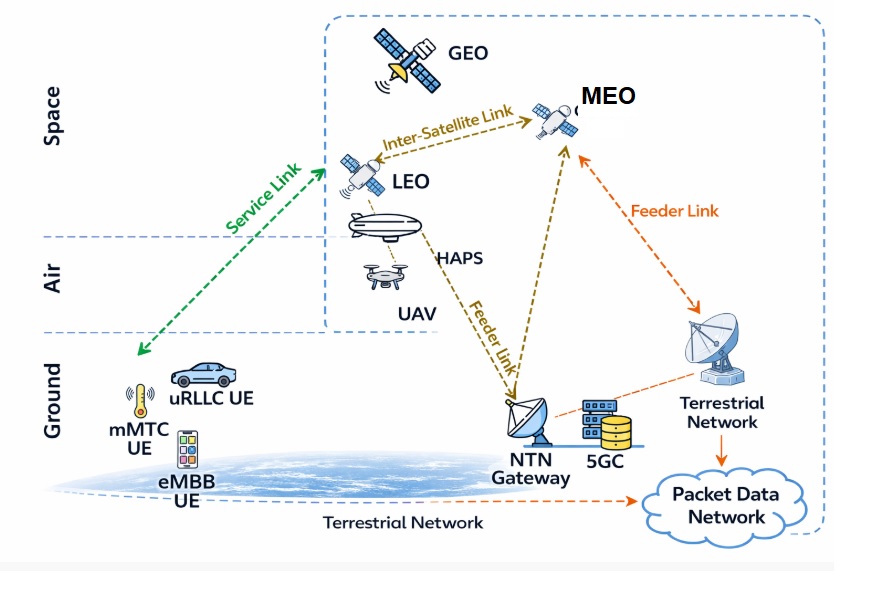
In this post, we covered a comprehensive detailed about most common terminologies used while working with NTN network, structured from a 3GPP system perspective, and intended for telecom engineers, system architects, researchers, and standardization professionals.
What is 3GPP NTN Technology?
- 3GPP NTN: A 3GPP NTN is a network where the radio access node is deployed on a spaceborne or airborne platform such as satellite or HAPS, instead of fixed terrestrial infrastructure. NTNs networks are usually used for extending the coverage to areas where ground-based Terrestrial network deployment is impractical or economically not feasible. 3GPP standpoint, NTN is not a separate technology, but an extension of 5G New Radio (NR). The same NR protocols, numerologies, and procedures are reused wherever possible and adapted to support Long propagation delays, High Doppler shifts, Large cell sizes and Platform mobility.
NTN Platform Terminologies: Satellite Orbits
One of the most fundamental NTN terminologies relates to satellite orbit classification, which directly impacts latency, coverage, and mobility behavior.
- Geostationary Orbit (GEO): GEO satellites are positioned at approximately 35,786 km, they appears stationary relative to the Earth. GEO satellites provide wide coverage, but suffer from high round-trip latency, and unsuitable for latency-sensitive services.
- Medium Earth Orbit (MEO): MEO satellites operate between 2,000 and 20,000 km. They offer a balance between coverage and latency, though they are less emphasized in current 3GPP NTN specifications.
- Low Earth Orbit (LEO): LEO satellites operate at altitudes between 300 and 2,000 km. They provide low latency and high throughput but move rapidly relative to the Earth, leading to frequent inter satellite handovers and significant doppler effects.
- Very Low Earth Orbit (VLEO): VLEO refers to experimental satellites designed to operate below 300 km. They promising ultra-low latency but facing significant atmospheric challenges.
- High Altitude Platform Station (HAPS): HAPS operates at altitudes typically between 20 and 50 km. HAPS platforms may include: Solar-powered unmanned aerial vehicles, Balloons and Airships. A HAPS can be used as NR base stations, relays, or coverage enhancers, offering quasi-stationary behavior with significantly lower latency compared to satellites.
NTN Radio Access Terminologies
- NTN gNB: An NTN gNB is a 5G NR base station modified for non-terrestrial deployment. Based on the architecture, an NTN gNB can be fully hosted onboard a satellite or HAPS, can be Partially deployed in space and partially on the ground or it can be fully ground-based with satellite acting as a relay. The functional split between space and ground is a critical design choice.
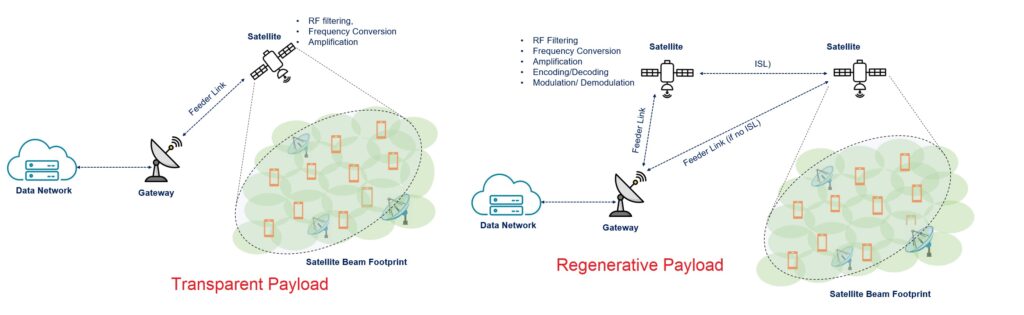
- Transparent Payload or Bent-Pipe Architecture: In a transparent payload or bent-pipe architecture, the satellite does not perform baseband processing. It is design to simplifies satellite design, however its operation high dependent on ground infrastructure and feeder link availability. A transport payload performs following function.
- Receives the RF signal from the UE
- Frequency-shifts and amplifies it
- Forwards it to a ground-based gNB via the feeder link
- Regenerative Payload: A regenerative payload performs partial or full Layer-1 and Layer-2 processing onboard the satellite. In this model, the satellite itself hosts gNB functionality. This architecture reduced feeder link latency, Improved scalability, Localized decision-making However, regenerative payloads increase satellite complexity and cost.
NTN Link Terminologies
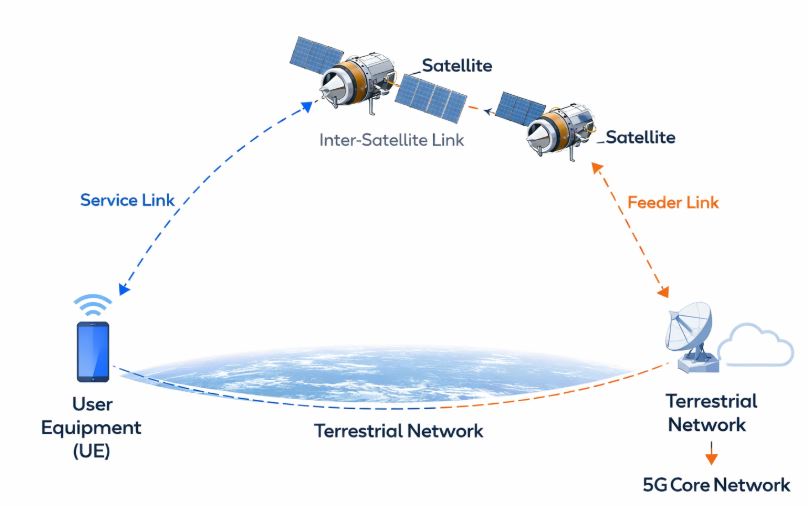
- Service Link: The service link refers to the radio connection between the User Equipment (UE) and the NTN platform (satellite or HAPS). It uses NR air interface waveforms adapted for large cell radius and extended timing advance.

- Feeder Link: The feeder link connects the satellite to the gateway earth station, which interfaces with the 5G Core Network. Feeder links typically operate at higher frequencies and require high-capacity backhaul.
- Inter-Satellite Link (ISL): Inter-Satellite Links (ISL) enable direct communication between satellites, allowing data to be routed through space without immediate ground station involvement. ISLs enhance resilience and reduce end-to-end latency.
NTN Network Architecture Terminologies
- Gateway Earth Station: A gateway earth station serves as the interface between the satellite system and the 5G Core Network. It anchors feeder links and plays a key role in mobility and session continuity.
- NTN-Enabled 5G Core: From a protocol perspective, the 5G Core Network (5GC) remains largely unchanged. Enhancements focus on: Supporting long latency, Handling large cell sizes and Optimizing idle and connected mode procedures.
- Direct-to-Device (D2D NTN): UE communicates directly with satellite/HAPS without intermediate terrestrial access.
- Hybrid NTN-TN Architecture: NTN complements terrestrial networks for fallback, offload, or coverage extension.
- Relay-Based NTN: Satellites or HAPS act as relay nodes between UEs and terrestrial gNBs.
- NTN Functional Split: Functional split refers to how RAN processing is divided between ground and non-terrestrial nodes:
-
- Centralized gNB: Full processing on ground
- Distributed gNB: PHY/MAC in space, higher layers on ground
- Fully Regenerative gNB: Complete gNB in orbit
-
NTN Beam Management Terminologies
- Spot Beam: Spot beams are highly directional beams used to Increase spectral efficiency, Enable aggressive frequency reuse and Improve link budget
- Beam Hopping: Beam hopping dynamically reallocates beams across geographic regions based on traffic demand, allowing efficient use of limited satellite resources.
- Moving Cells: In NTN, cells move relative to the Earth’s surface as satellites orbit. The UE may remain stationary while the serving cell changes, reversing the traditional terrestrial mobility paradigm.
NTN Spectrum and Frequency Terminologies
- NTN Frequency Bands: 3GPP NTN specifications are band-agnostic but account for propagation differences. NTN operates across:
- L-band / S-band: IoT and low data rate services
- Ku-band / Ka-band: Broadband NTN
- Q/V-band: Future high-capacity feeder links
- Frequency Reuse in NTN: Aggressive frequency reuse is achieved via:
-
- Spot beam isolation: High-gain, narrowly focused spot beams limit inter-beam interference, enabling the same frequency resources to be reused across geographically separated coverage areas.
- Polarization reuse: Orthogonal signal polarizations (e.g., horizontal and vertical or RHCP/LHCP) are reused within the same frequency band to effectively double spectral efficiency without additional bandwidth.
- Beam hopping coordination: Time-synchronized activation of beams allows the same frequencies to be reused across different regions by dynamically allocating satellite resources based on traffic demand.
-
NTN UE and Positioning Terminologies
- NTN-Capable UE: An NTN-capable UE supports: Extended timing advance, Doppler estimation and compensation, GNSS integration. Such UEs may also support both terrestrial and NTN modes.
- NTN UE Power Class: NTN UEs may operate at: Higher transmit power, Adaptive power control to compensate for FSPL. Power class impacts battery life and device form factor.
- UE Antenna Gain and Orientation: UEs may use: Directional antennas, Electronically steerable antennas or Fixed omnidirectional antennas (with performance trade-offs)
- GNSS Assistance: Global Navigation Satellite System (GNSS) assistance is fundamental in NTN for: UE positioning, Time and frequency synchronization and Mobility prediction
- Doppler Shift: Doppler shift is change in observed frequency due to mobility of moving target. Due to high relative velocities specially in LEO systems, Doppler shift is significantly higher than in terrestrial networks. NTN systems rely on: GNSS-assisted UE positioning, Doppler pre-compensation, Enhanced frequency tracking mechanisms
- Timing Advance (TA) Extension: Timing Advance (TA) compensates for signal propagation delay. In NTN, TA values are significantly extended, GNSS-assisted TA is often required and TA validity may change dynamically due to satellite movement
- Common Timing Reference: In NTN accurate timing is critical for OFDM orthogonality. For timing reference systems rely on: GNSS-based time reference, Network-distributed synchronization via gateways, Onboard atomic clocks (advanced systems).
- Round Trip Time (RTT): RTT is a critical NTN performance metric and values influence HARQ, RLC timers, and mobility procedures.
- LEO: ~20–40 ms
- MEO: ~100–150 ms
- GEO: ~500–600 ms
- Ephemeris Data: Ephemeris data provides precise satellite orbit information which can be used for Mobility prediction, Doppler compensation and Beam scheduling
- ITU Filing: Satellite systems must comply with: ITU spectrum filings, Orbital slot coordination and Cross-border interference rules
NTN Mobility and Handover Terminologies
- Earth-Fixed Cell: Logical cell remains fixed on Earth despite satellite motion
- Earth-Moving Cell: Cell footprint moves with the satellite
- Satellite Handover: A Hanover occurs when
-
- UE switches from one satellite to another,
- Gateway changes due to satellite movement,
- Beam switching is required within the same satellite
- Satellite handovers are predictable and can be pre-scheduled.
-
- Make-Before-Break Handover: NTN use make before break handovers to avoid session drops during fast satellite transitions.