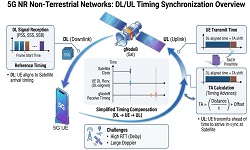
Satellite Ephemeris in 5G NTN
Introduction
The advancement of 5G NTN is transforming global connectivity by integrating LEO, MEO, and GEO satellites into the 5G ecosystem. Unlike terrestrial base stations, satellites are constantly moving, introducing significant challenges in timing, synchronization, Doppler shift, and mobility management.
To enable NTN operations one of the most critical information is Satellite Ephemeris. The ephemeris data is fundamental requirement to the operation of every NTN UE, satellite, and gNodeB. Without correct knowledge of satellite position and velocity, the network cannot establish or maintain a reliable radio link.
In simple words:
Satellite Ephemeris allows both the network and the UE to know where a satellite is, how fast it is moving, and where its will be in the near future.
The Satellite Ephemeris information transforms a highly dynamic space environment into a manageable wireless communication system.
What is Satellite Ephemeris?
Satellite ephemeris is a precise, time-stamped dataset describing the orbital state of a satellite. Rather than transmitting its position every second, the satellite broadcasts mathematical parameters that allow receivers to calculate its current and future position with high accuracy.
A typical ephemeris contains:
- Satellite position (X, Y, Z) in ECI or ECEF coordinates
- Satellite velocity (Vx, Vy, Vz)
- Reference epoch (time of validity)
- Orbital parameters (semi-major axis, eccentricity, inclination, RAAN, argument of perigee, mean anomaly)
- Clock correction parameters
- Propagation validity period
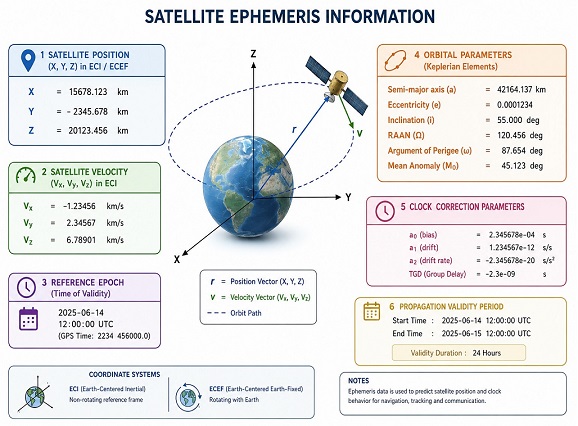
These parameters enable both the network and the UE to predict satellite movement throughout the validity window.
5G NR NTN Satellite Ephemeris Information
In 5G NR NTN, the satellite ephemeris is provided during initial access as broadcast information in System Information Block19 (SIB 19) as ephemerisInfo IE. One may have question that how does the UE Obtain Satellite Ephemeris? In 3GPP, there are following defined mechanisms to deliver ephemeris information:
- Broadcast via System Information: Ephemeris is transmitted periodically through System Information Blocks (SIBs).
- Dedicated RRC Signaling: The network provides updated ephemeris during Radio Resource Control procedures.
- NAS or Application Layer: Ephemeris may be pre-loaded or downloaded through higher-layer signaling.
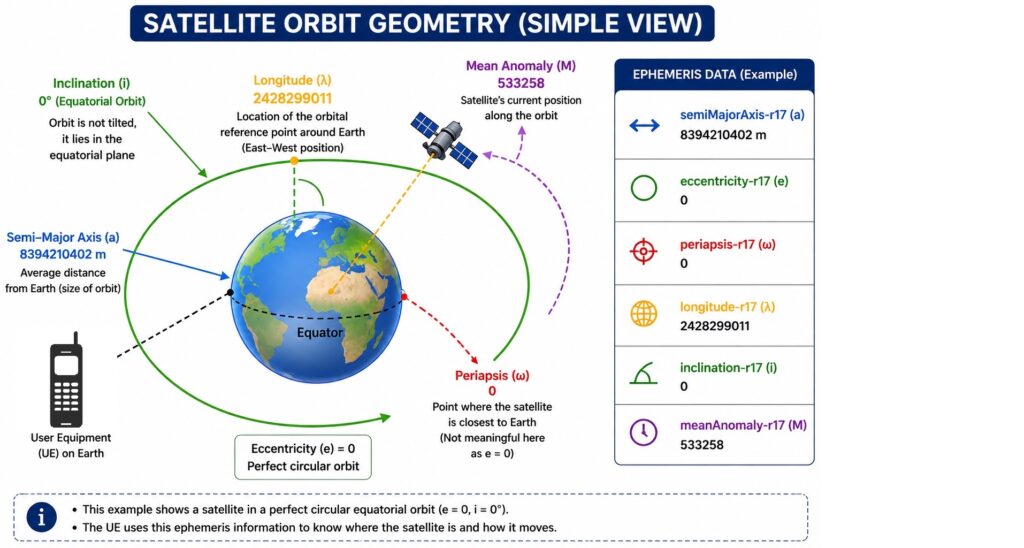
A sample log is shown in following figure. The data shown is used to tells the UE where the satellite is and how it is moving so that the UE can maintain consistent RF connectivity.
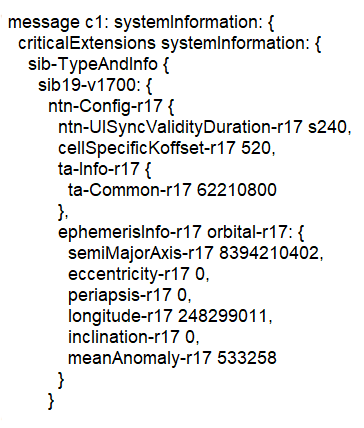
| Parameter | Value | Meaning |
|---|---|---|
| semiMajorAxis-r17 | 8394210402 | This represents the size of the satellite’s orbit. Think of it as the average distance of the satellite from the Earth. A larger value means the satellite is farther away. |
| eccentricity-r17 | 0 | This tells how circular the orbit is. A value of 0 means the satellite travels in a perfect circular orbit. If the value were greater than 0, the orbit would be oval (elliptical). |
| periapsis-r17 | 0 | Periapsis is the point where the satellite is closest to Earth. Since the orbit is circular (eccentricity = 0), this value doesn’t really matter. |
| longitude-r17 | 2428299011 | This indicates where the satellite (or orbital reference point) is located around the Earth in terms of longitude. It helps the UE determine which satellite is overhead. |
| inclination-r17 | 0 | Inclination tells how tilted the orbit is compared to Earth’s equator. A value of 0° means the satellite moves directly above the equator (Equatorial Orbit). |
| meanAnomaly-r17 | 533258 | This tells the satellite’s current position along its orbit at a specific time. Imagine the orbit as a race track—this value tells where the satellite currently is on that track. |
Ephemeris Flow in Non-Terrestrial Networks (NTN)
The ephemeris flow in a NTN begins with Ground Monitoring Stations, which continuously track satellite signals and collect orbital measurements such as position, velocity, and clock information. These measurements are processed by the Network Control Center and determine the orbit, where the satellite’s precise trajectory and clock corrections are calculated.
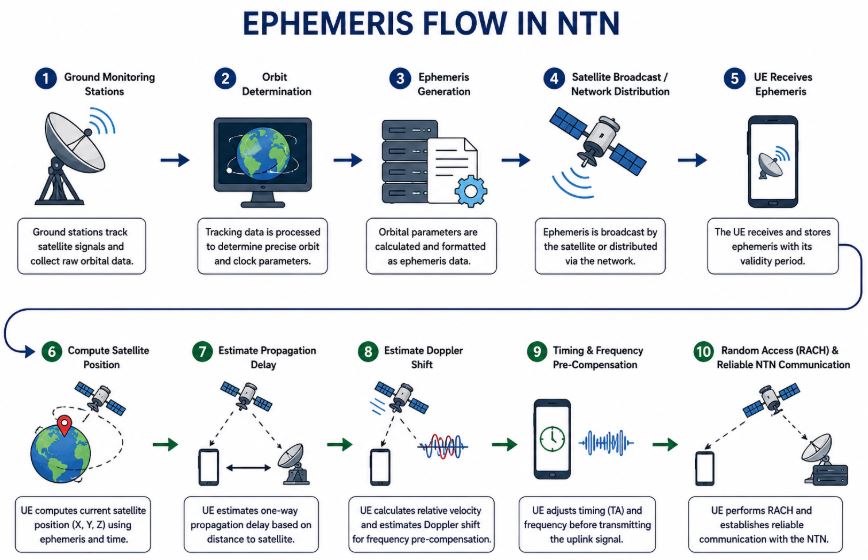
Based on this information, an ephemeris dataset containing orbital parameters, reference time, and validity period is generated and distributed either through the satellite broadcast channel or the terrestrial network. The UE receives and stores the ephemeris, using it together with its own GNSS location and time information to compute the satellite’s current position.
From the calculated satellite position, the UE estimates the one-way propagation delay and the expected Doppler frequency shift caused by the satellite’s high orbital velocity. These estimates enable the UE to perform TA pre-compensation and frequency pre-compensation before transmitting the uplink signal.
As a result of this, the UE can successfully perform the RACH procedure, maintain synchronization with the satellite, and establish a reliable communication link. This continuous ephemeris update process is fundamental to NTN operation, allowing the network to compensate for the dynamic movement of satellites and ensuring seamless connectivity, efficient mobility management, and robust radio performance.
Why Satellite Ephemeris is Essential in NTN
In NTN networks, satellites are constantly moving in space. This continuous movement introduces several challenges that do not exist in traditional 4G or 5G terrestrial networks. To overcome these challenges, Satellite Ephemeris provides precise information about a satellite’s current and future position, velocity, and orbital characteristics, enabling the UE and the NTN infrastructure to maintain reliable communication.
For example:
- LEO satellites travel at approximately 7.5 km/s (27,000 km/h).
- A LEO satellite typically completes one orbit around the Earth in 90–120 minutes.
- The satellite’s footprint (coverage area) continuously moves across the Earth’s surface.
- A user (UE) on the ground is actually communicating with a rapid moving base station in space.
- The relative distance between the satellite and the user changes every second.
Because of this dynamic environment, the network must always know following to maintain reliable rf link between UE and satellite:
- Where the satellite is located and Where it will move next
- How fast it is moving and how long it will remain visible
- When another satellite should take over the connection
This information is precisely what Satellite Ephemeris provides.
Challenges Without Satellite Ephemeris
- Unknown Satellite Position: The UE and network cannot correctly determine the satellite’s current location, making it difficult to establish communication.
- Synchronization Failure: Without precise position information of satellite, timing synchronization between the UE and satellite becomes inaccurate.
- Incorrect Propagation Delay Estimation: The continuously changing distance between the satellite and UE causes inaccurate delay calculations, resulting in transmission errors.
- Severe Doppler Frequency Shift: The UE cannot accurately compensate for the rapidly changing Doppler shift caused by the satellite’s high velocity, leading to frequency synchronization issues.
- Beam Tracking Failure – The network cannot predict the movement of satellite spot beams, causing users to lose beam alignment and signal quality.
- Unreliable Cell Selection – The UE cannot determine the most suitable moving satellite or cell, resulting in poor initial access and frequent connection failures.
- Inefficient Cell Reselection – The UE cannot anticipate when a serving satellite will move out of coverage, causing delayed or failed cell reselection.
- Random Access (RACH) Failures – Incorrect timing estimation increases the probability of PRACH collisions and unsuccessful network access.
- Frequent Handover Failures – The network cannot predict upcoming satellite changes, leading to interrupted sessions and dropped connections during handovers.
- Reduced Quality of Service (QoS) – Higher latency, packet loss, retransmissions, and unstable radio links degrade overall service quality.
Increased Signaling Overhead – Additional signaling is required to repeatedly estimate satellite parameters, consuming valuable radio resources.
Lower Spectral Efficiency – Timing and frequency errors reduce radio resource utilization, decreasing network capacity and throughput.
Reduced Positioning Accuracy – Applications relying on precise satellite geometry experience degraded location estimation and navigation performance.
Connection Drops and Service Interruptions – Overall communication becomes unstable, resulting in frequent link failures and degraded user experience.
How Ephemeris Supports NTN Operation
Timing Advance (TA) Pre-Compensation
In terrestrial NR, the gNB measures uplink arrival time and instructs the UE to adjust its Timing Advance. In NTN, however, satellites may be hundreds or even thousands of kilometers away, causing propagation delays ranging from tens to hundreds of milliseconds. Traditional Timing Advance procedures are therefore insufficient for NTN operation.
An solution for this problem has been introduced as Timing Advance Pre-Compensation, where the UE combines Satellite ephemeris and Its own GNSS-derived position to estimate the one-way propagation delay before transmitting. The benefits of using ephemeris allows the UE to Estimate satellite distance, Calculate propagation delay, Align uplink transmission timing and Improve Random Access (RACH) success.
Doppler Pre-Compensation
LEO satellites move at approximately 7.5 km/s, the received frequency experiences significant Doppler shift. The Doppler offset may exceed ±48 kHz, much larger than in terrestrial cellular systems and traditional methods does not work for NTN operation.
A solution can be where UE can use satellite ephemeris to calculates can Satellite velocity, Relative motion and Expected Doppler frequency and later using these calculations UE then pre-compensates doppler offset in its uplink frequency before transmission.
Beam and Cell Management
In NTN, beams continuously move as the satellite travels along its orbit. Consequently, the serving cell changes even when the UE remains stationary. The Satellite ephemeris information enables:
- Cell selection
- Beam prediction and switching
- Mobility management with proactive handover preparation
This significantly reduces service interruption during satellite movement.
Gateway (Feeder Link) Synchronization
Satellite ephemeris is equally important for NTN gateways. As satellites move, the propagation delay between the gateway and satellite continuously changes. Ephemeris allows gateways to:
- Estimate satellite position
- Adjust feeder-link timing
- Maintain synchronization
- Support bent-pipe satellite operation
Without continuous ephemeris updates, feeder-link synchronization may gradually drift, degrading overall network performance.
Paging and DRX Optimization
Satellite coverage over a location is available only during specific time windows. Satellite ephemeris allows Network to predict UE visibility and schedule paging efficiently. For UE ephemeris information allows to predict satellite coverage windows and wake up only when service is available. The Benefits of this in reduced battery consumption, Improved paging efficiency and Optimized DRX cycles
Mobility and Handover
Mobility in NTN significantly different from terrestrial networks. Instead of users moving between fixed cells, satellites and beams move across stationary users. Ephemeris information can enables following:
- Satellite trajectory estimation and Future beam prediction
- Handover preparation and Continuous session management
This predictive approach minimizes call drops and enhances user experience.
Conclusion
Satellite ephemeris is much more than orbital information. It is a fundamental enabler of 5G Non-Terrestrial Networks. Satellite ephemeris information transformed the rapidly moving space environment into a predictable and reliable RAN network.
With correct satellite position and motion, ephemeris allows both the network and the UE to synchronize transmissions, compensate for Doppler effects, manage moving beams, optimize paging, and maintain seamless mobility.
As satellite based communication becomes an integral part of 5G Advanced and future 6G systems, efficient ephemeris management will remain one of the key technologies enabling truly global, uninterrupted connectivity.
References
- 3GPP TR 38.821 – Solutions for NR to Support Non-Terrestrial Networks (Release 16)
- 3GPP TS 38.300 – NR; Overall Description (Release 17/18)
- European Space Agency (ESA) – Navigation and Satellite Systems
- International GNSS Service (IGS) – Precise Orbit and Ephemeris Products
- GPS.gov – Official U.S. Government GPS Information
Related Posts
- NTN RACH Procedure Impacts – NTN RACH
- HARQ in NTN – HARQ Requirement Analysis for NTN
- System Information 19 – SIB19 For 5g Satellite NTN
- 5G NTN Quality of Service – 5G NTN QoS
- Handover in Non-Terrestrial Networks
- Conditional handover (CHO)