


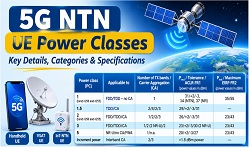
In NTN as well, the UE is also considered an important part of the overall network architecture. 3GPP Releases 18 and 19 has introduced several enhancements to support different types of UEs operating in NTN networks.
Based on Capabilities and operating modes, NTN UEs can be classified into different categories,
- Unmodified UEs,
- Handheld UEs,
- IoT-NTN UEs, and VSAT UEs.
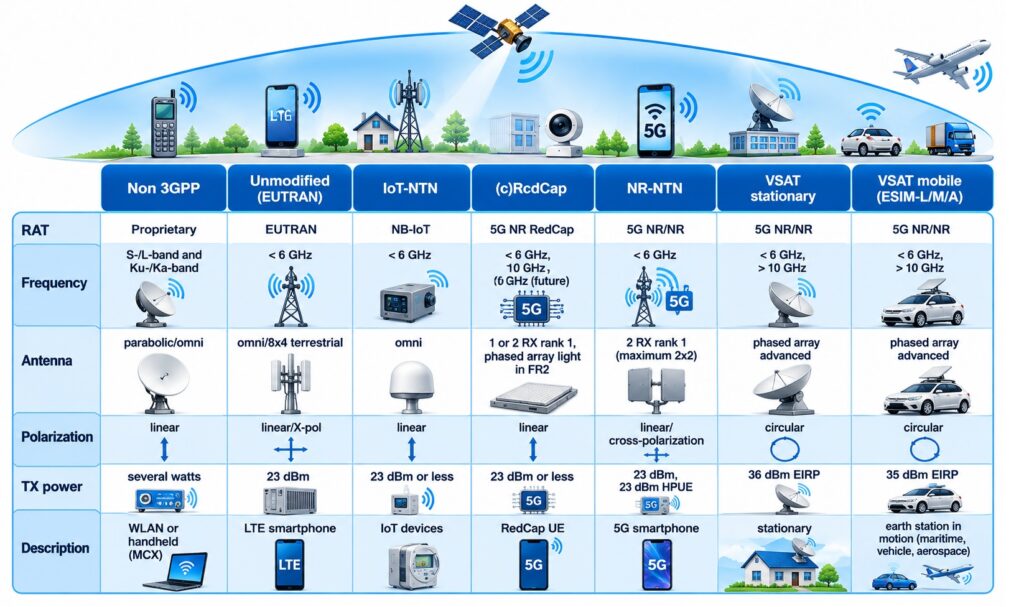
Some of these categories, particularly IoT-NTN and VSAT devices, require additional enhancements and support in the 3GPP specifications. There are several other parameters and capabilities are used to classify these UE categories. Following figure shows a simplified overview of the most common UE types and their key characteristics.

NTN UE Categories
- Non-3GPP UE: This type of UEs are designed to work with existing satellite operators and support specific satellite services. They use proprietary communication technologies and waveforms rather than 3GPP-standardized technologies.
- Unmodified UE: This type UEs are used for proprietary satellite communication and Direct-to-Cell (DTC) services. For proprietary satellite communication, the satellite operator and UE manufacturer work together to enable satellite connectivity. Any required changes to the UE are decided by the manufacturer and do not necessarily follow 3GPP specifications. In the Direct-to-Cell (DTC) approach, existing mobile phones use their normal cellular technology, while the satellite network handles the necessary changes to support communication through satellites.
- IoT-NTN UE: These UE includes IoT devices that support technologies like NB-IoT and LTE-M. To work in NTN networks, these devices requires some additional capabilities. E.g., they must support GNSS to determine their location and the protocol enhancements introduced in 3GPP Release 17. These enhancements include:
- Timing compensation: Parameters like K_offset and enhanced Timing Advance (TA) are included to manage the long signal delays caused by satellite communication.
- Doppler compensation: The UE adjusts its transmission frequency to handle frequency shifts caused by satellite movement.
- Enhanced signaling: Support for SIB31 and SIB32, along with extended RRC and NAS procedures, helps the UE communicate properly with the NTN network.
- (e)RedCap UE: RedCap – Reduced Capability is a 3GPP technology designed for devices that need fewer capabilities than a regular 5G smartphone. It helps reduce device complexity, cost, and power consumption. Initially, RedCap was introduced in Release 17 for terrestrial networks. Later, Release 19 extended NTN support to specific RedCap devices. To work in NTN networks, RedCap devices must also support additional protocol enhancements to handle satellite communication requirements. Some of these enhancements are listed below.
- eRedCap devices may support bandwidths of only 5 MHz or 3 MHz.
- The UE can indicate its support for (e)RedCap through capability signaling using the parameter `ntn-ERedCap-FR1-r19`.
- Another important requirement is GNSS support, Unlike terrestrial RedCap devices, RedCap UEs operating in NTN networks are required to support GNSS to provide location information.
- HD-FDD operation and timing challenges enhancements
- Handheld UE: This category covers NR-NTN devices operating in the FR1 frequency range, mainly handheld devices such as smartphones. To support satellite communication, these devices need several enhancements introduced in 3GPP Release 17 and later releases.
- These include timing delay compensation, Doppler frequency compensation, improved RRC and NAS signaling, and updated mobility procedures.
- By default, handheld NTN UEs use Power Class 3 (23 dBm) and support omnidirectional or basic directional antennas. They do not support circular polarization.
- VSAT-Type UE: VSAT (Very Small Aperture Terminal) is a broad category that covers different types of satellite communication terminals rather than one specific UE type. These terminals may be installed in vehicles, aircraft, ships, or fixed locations. In general, VSAT-type UEs are expected to support higher frequency bands above 10 GHz, particularly Ku-band and Ka-band. They may also use advanced beamforming antennas and support circular polarization to improve satellite connectivity.
NTN UE Power Class Aspects
3GPP defines different UE power classes based on transmission and reception capabilities. These requirements are covered in TS 38.101 specification, which includes different versions for FR1, FR2, 5G standalone (SA), non-standalone (NSA), and satellite access (TS 38.101-5).
The supported power class depends on the frequency band and UE category. E.g., in FR2, 3GPP defines UE categories for Fixed Wireless Access (FWA), handheld devices, vehicles, trains, roof-mounted terminals, RedCap, and high-power non-handheld devices. In FR2, UEs generally use beamforming with phased-array antennas. Therefore, their transmit power is specified in terms of maximum EIRP (Equivalent Isotropically Radiated Power), using a spherical measurement approach.
For FR1 NTN, Power Class 3 (PC3), which supports a maximum transmit power of 23 dBm, is the default for UEs. Higher power classes, such as Power Class 1 (PC1), are generally not intended for smartphone-type devices. Figure 30 provides an overview of these UE power class requirements.
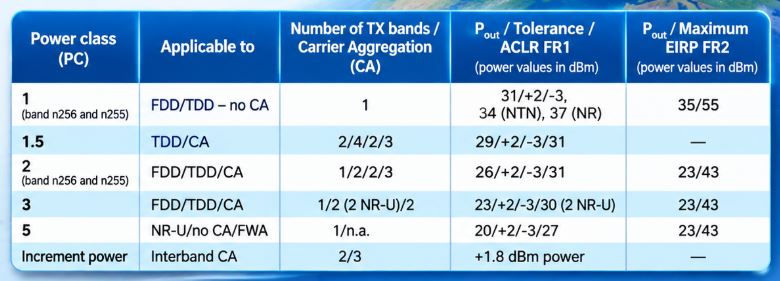

3GPP is also discussing higher transmit power for specific UE types and applications. Initially, Power Class 1 was mainly considered for stationary VSAT terminals used in Fixed Wireless Access (FWA). However, recent discussions have also considered higher power classes for IoT devices operating in remote areas, where battery limitations may be less critical.
Higher Power Class UEs (HPUEs) are also being considered for mission-critical communications (MCX). These may include handheld devices with higher transmit power. Some proposal suggests introducing PC1 and PC2 power classes for 3 MHz RedCap devices [RP-261551].
As part of the Release 18 coverage enhancement work, 3GPP is addressing uplink link budget limitations by considering UEs with higher transmit power. The detailed power class requirements are covered in the TS 38.101-5 specification for satellite communication,
There are some minor differences between NTN and FR1 or FR2 transmit and receive characteristics. For example, NTN permits a maximum adjacent channel leakage ACLR of 34 dB while FR1 allows 37 dB as a minor difference. As a major difference, FR2 uses the metric EIRP, considering the directive TX characteristics of the UEs.
Related Post
- NTN RACH Procedure Impacts – NTN RACH
- HARQ in NTN – HARQ Requirement Analysis for NTN
- System Information 19 – SIB19 For 5g Satellite NTN
- 5G NTN Quality of Service – 5G NTN QoS
- Handover in Non-Terrestrial Networks
- Conditional handover (CHO)