


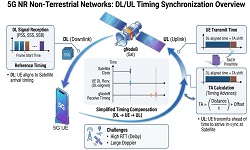
5G NR Non-Terrestrial Network (NTN), downlink and uplink timing synchronization between the UE and gNB has introduces several unique challenges while comparing with the traditional 5G NR networks (TN). The primarily reason for this is the larger and high variable propagation delays and significant doppler effects resulted because of moving satellites. The procedures, parameter considerations, and technical enhancements are markedly distinct.
Downlink Synchronization is NTN (gNodeB —>UE)
In both TN and NTN, the downlink synchronization (gNodeB —>UE ) process starts with the UE detecting the broadcast information PSS/SSS by the gNodeB. This allows the UE to determine cell identity, frame timing, and frequency alignment.
For NTN, the delay between the satellite based gNodeB and the UE can be in the range from tens to hundreds of milliseconds (e.g., ~240 ms for GEO orbits), this makes precise frame and frequency alignment more critical.
In NTN, to take case these long delays, the gNodB broadcasts additional information in SIB19 called NTN assistance broadcast information, conveying satellite ephemeris, current satellite position, and timing advance parameters so that the UE can estimate and compensate for delay and Doppler shift before uplink initiation.
Uplink Synchronization in NTN – TA and Pre-Compensation
In TN, uplink timing synchronization (UE —>gNodeB) mainly relies on the Timing Advance (TA) procedure, where the gNodeB adjusts the UE’s transmission timing based on the measured round-trip travel time. TA values are relatively small (in the order of a few microseconds to milliseconds).
In NTN, before random access, the UE must autonomously pre-compensate the TA and frequency offset based on following
- GNSS-derived UE position (if available)
- Satellite’s ephemeris and velocity
- gNodeB signaled common Timing Advance (Common TA)
The UE estimates the expected round-trip time from its location to the satellite/co-located gateway, then adjusts its uplink transmission timing accordingly. If GNSS or ephemeris information is missing, the UE may not transmit until these are restored.
Key Timing Parameters for NTN DL/UL Synchronization
Following table show the key timing parameters important for DL/UL synchronization. These parameters are configured and signaled to the UE to enable reliable scheduling and HARQ operations. The UE may also periodically report its TA in connected mode, with “triggered” reporting in NTN to handle the satellite’s movement-induced changes.
| Parameter | Role in NTN | Typical / Example Value | Protocol-Test Relevance |
|---|---|---|---|
| Common TA | Offset for RTT between Ref. Point & payload | ~~120 ms for a GEO one-way path of ~36,000 km | Determines when UL transmissions are expected at the network side |
| K_offset | Scheduling offset for DL-to-UL gap | RTT + common TA, | Critical when validating DL-to-UL scheduling and HARQ timing |
| K_MAC | Offset for MAC layer scheduling | Related to NTN RTT and configured timing parameters | Affects PDSCH/PUSCH scheduling, HARQ, and MAC procedure validation |
| Doppler Precomp | Frequency shift compensation | Up to several kHz (LEO) | Important for validating frequency synchronization, PRACH access, PUSCH/PDSCH reception, and link stability |
Comparison DL/UL Synchronization for NTN and TN
Following table provide a comparison on DL/UL synchronization for NTN and TN
| Feature | Terrestrial Network (TN) | Non-Terrestrial Network (NTN) |
|---|---|---|
| DL Sync | PSS/SSS detection, usually sub-ms delay | PSS/SSS + SIB19/ephemeris info, long delay |
| Uplink Timing | gNB-triggered TA (µs-ms) | Pre-compensation by UE (100s ms) |
| Doppler | Minimal (unless High SpeedTrain) | Essential; UE calculates Doppler/frequency shifts |
| Signaling | Standard RRC messages, TA cmd | SIB19, Common TA, satellite ephemeris data |
| Random Access | Standard PRACH, fast feedback | PRACH pre-delay, slow HARQ, GNSS aided |
| Practical challenges | Site densification, sector calibrations | GNSS dependency, ephemeris, orbit dynamics |
Testing NTN DL/UL Synchronization in Lab
To validate downlink and uplink synchronization for 5G NR NTN networks considering the feeder-link delay involves the following key steps:
Test Setup:
Configure the NTN test environment with a transparent payload satellite or HAPS relay.
- Set up the ground gNB (or gateway) and ensure that it broadcasts NTN-specific system information including SIB19 with satellite ephemeris and feeder-link delay parameters.
- Ensure UE supports NTN features including GNSS-based positioning for timing advance pre-compensation.
Downlink Synchronization Validation:
- Power on the UE and allow it to acquire synchronization signals (PSS/SSS) from the gNB via the transparent payload.
- Confirm that UE decodes SIB19 and receives accurate satellite ephemeris and feeder-link delay info.
- Measure the UE’s downlink frame timing relative to the expected arrival time calculated from feeder-link delay, satellite position, and gNB frame timing.
Uplink Timing Advance Validation with Feeder-Link Delay:
- UE uses GNSS location and broadcast ephemeris/feeder-link delay info for initial uplink timing advance pre-compensation.
- UE sends PRACH preamble with pre-compensated timing to ground gNB.
- Ground gNB measures actual reception timing then sends a Timing Advance Command (RRC MAC CE) if further TA adjustment is needed.
- Confirm that uplink transmissions (PRACH and subsequent UL data) align within the expected timing window when accounting for feeder-link delay and round trip propagation time.
Dynamic Delay and Drift Testing:
- Test feeder-link delay variations and drift rate (which can be up to ±24 µs/sec or ppm scale).
- Measure synchronization maintenance by monitoring TA updates and drift compensation via network signaling (e.g., Timing Advance Command or updated SIB info).
- Evaluate performance under satellite mobility scenarios (e.g., LEO satellites) to ensure synchronization robustness.
Validation Performance Metrics:
- Timing offset between expected and actual symbol/frame arrival at UE for DL.
- TA error margin on the uplink between UE transmission and gNB reception.
- Impact of feeder-link delay variations on HARQ timing and round trip time.
- Validating extended timers (e.g., T300, T319) to support NTN long delay operations.
Conclusion
The basic DL/UL synchronization procedure remains similar in NTN to the terrestrial 5G NR. The NTN still uses PSS/SSS for downlink synchronization and Timing Advance (TA) for uplink timing. However, NTN is more challenging because signals travel much longer distances, experience Doppler shifts, and the satellite is constantly moving.
To handle these challenges, NTN uses additional parameters such as Common TA, K_offset, K_mac, and SIB19, along with regular position and satellite ephemeris updates. These parameters help the UE maintain accurate timing and frequency synchronization as the satellite moves.