


Introduction
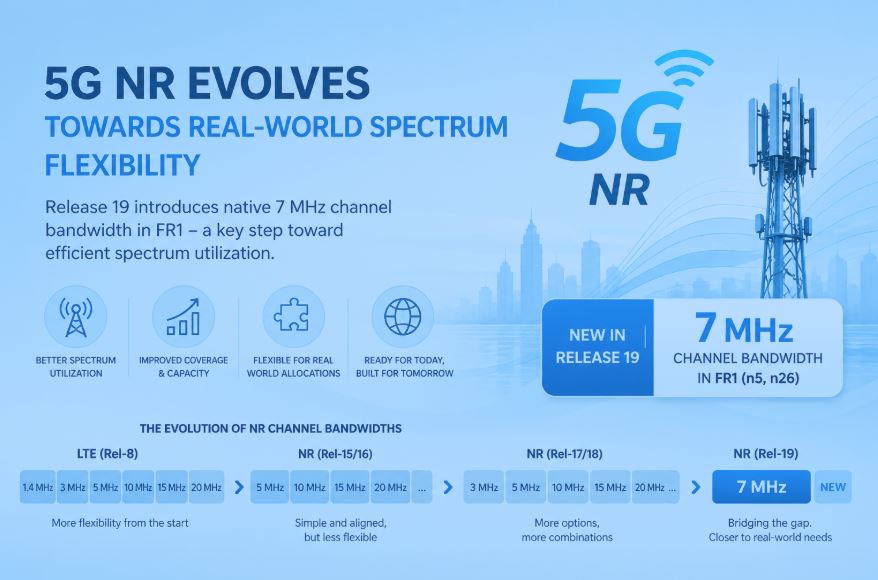
3GPP Release 8, TS 36.101 specification had defined multiple channel bandwidth options for 4G which includes 1.4, 3, 5, 10, 15, and 20 MHz. These flexible bandwidth options enabled operators to efficiently utilize licensed spectrum that they owned, even when available spectrum was not aligned to multiples of 5 MHz. By using Carrier Aggregation, operators could maximize spectrum efficiency across fragmented allocations.
Early 5G NR releases, supports channel bandwidths multiples of 5 MHz which became a constrained and reduce the flexibility for operators who hold irregular spectrum. Although the later NR release introduced 3 MHz bandwidth improved spectrum utilization possibilities e.g. enabling better carrier aggregation for 8 MHz and 13 MHz spectrum, but several operator spectrum allocations still remain inefficiently utilized.
Operators have specifically requested support for the following irregular NR channel bandwidths for different bands:
| Band | Requested Channel Bandwidth |
|---|---|
| n5 | 6, 7, 11, 12 MHz |
| n12, n85 | 6, 12 MHz |
| n26 | 7 MHz |
| n28 | 13 MHz |
| n29 | 6, 11 MHz |
Key Pointers
- Early, 5G NR adopted 5 MHz multiples channel bandwidths, prioritizing simplicity over flexibility
- Real-world spectrum is often fragmented and irregular, especially in low-band frequencies
- Early NR lacked flexibility to support 1.3 and 3 MHz, creating a gap between standardization and deployment reality.
- Release 17 introduced 3 MHz bandwidth, improving support for narrow and fragmented spectrum
- Release 18 defined a dedicated study items for efficient utilization of irregular bandwidths
- Operators highlighted demand for 6, 7, 11, and 12 MHz bandwidths based on spectrum holding
- Release 19 introduces 7 MHz bandwidth in FR1, targeting bands like n5 and n26.
- 7 MHz avoids issues seen in workarounds like overlapping carriers and larger bandwidth blocking
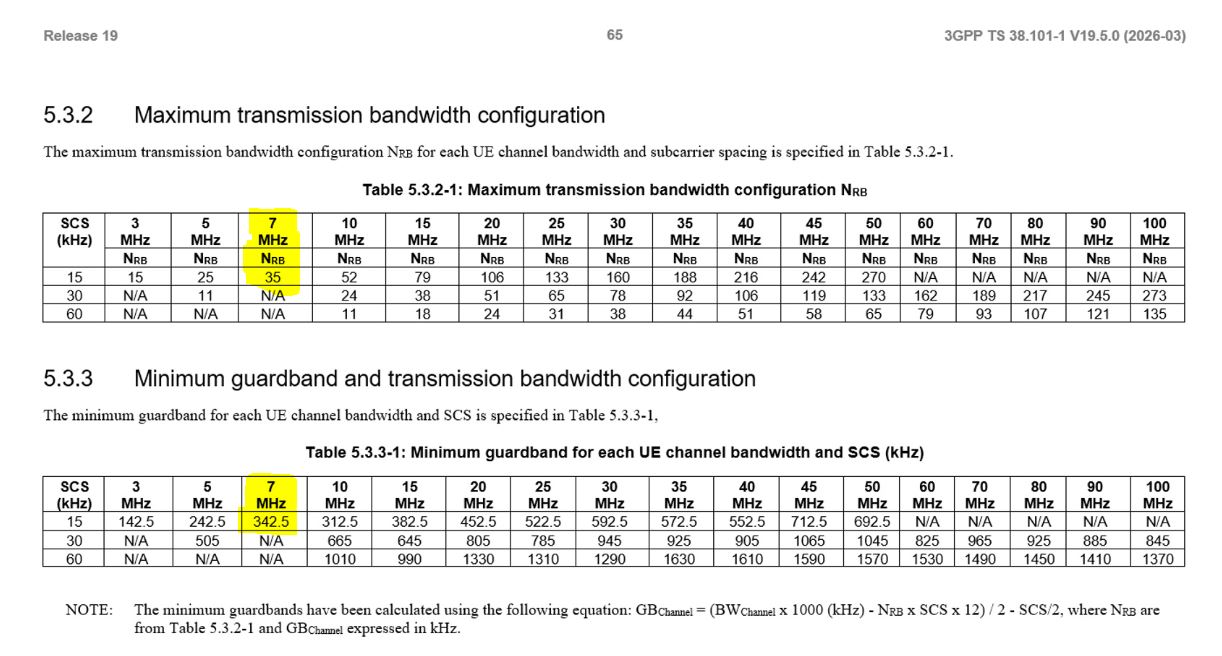
- 7MHz channel bandwidth support only 15KHz Subcarrier Spacing

Release 18 Study for Irregular Bandwidth Support
To address this irregular Bandwidth issue, Rel.18 introduced the a study item FS_NR_eff_BW_util i.e. Efficient Bandwidth Utilization for NR. The study concluded at RAN#99 with two technically promising approaches:
- Overlapping channels from the network perspective
- Multiple overlapping NR carriers are configured to cover irregular spectrum allocations.
- Next larger channel bandwidth
- Deploy a larger standardized NR bandwidth and block PRBs outside the licensed spectrum.
However, both approaches presented practical limitations:
- Overlapping channel approach
- Requires frequency-overlapped and time-offset SSB configurations for some bandwidths (e.g., 6 MHz and 7 MHz).
- These SSB arrangements may not be supported by legacy UEs, creating backward compatibility concerns.
- Next larger channel approach
- Risk of strong adjacent channel blocking/interference, especially in low-band coverage spectrum where neighboring operators are non-collocated.
- Blocked PRBs may suffer from adjacent operator emissions.
Due to these challenges and associated RAN4 test/unit (TU) limitations, broader irregular bandwidth support was deferred.
Release 19 Study for Irregular Bandwidth Support

In release 19 Work Item, the irregular bandwidth support scope is narrow down and agreement was reached to support only following:
- 7 MHz NR channel bandwidth for Band n5 (FDD, UL: 824-849 MHz, DL: 869-894 MHz )
- 7 MHz NR channel bandwidth for Band n26 (FDD, UL: 814 – 849 MHz, DL: 859 – 894 MHz)
This decision represents the first normative step toward commercialization of irregular NR bandwidths while minimizing implementation complexity and ecosystem impact.
Considering the findings from both the Release 18 Study Item and subsequent Release 19 discussions, normative work on native irregular bandwidth support starting with 7 MHz is now considered the most practical path for improving spectrum efficiency in fragmented lower band deployments.
Conclusion
The evolution for channel bandwidths support in 5G NR is now shifting from rigid design toward actual world practicality. The support of 7 MHz in Release 19 addresses a critical gap in utilizing fragmented lower bands spectrum efficiently. It reflects a broader move from theoretical standardization to deployment driven innovation, similar to what 4G LTE achieved earlier. Looking ahead, this sets the foundation for further flexibility, enabling operators to fully maximize their valuable investments in spectrum assets.
References
- RP-251453
- TS 38101-1 5G NR User Equipment (UE) radio transmission and reception Part 1
Related Posts
- 3GPP Release 19 Explained: Overview, Features and Work Items
- NVIDIA Sionna: An AI-Native 6G Wireless System Design Tool