5G NTN Quality of Service – 5G NTN QoS
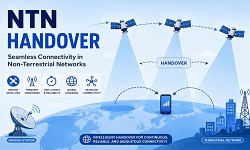
5G evolution is not limited to terrestrial network. 5G NTN introduce, mobile networks are expanding beyond ground-based base stations which include satellites, high-altitude platforms, and UAV systems. In the 5G system architecture, the major impact due to the introduction of NTN is considered to occur in the RAN where possible architecture models support transparent or regenerative architectures.
The user plane connectivity remains unchanged as the user plane function (UPF) provides data connectivity to the UE. As a minor impact, the UPF may interact with the possibility of establishing multiple PDU connections in parallel, and with respect to the session management, the UPF needs to tolerate the long delays associated with NTN connectivity. While data transmission is ongoing over the user plane (UP) connection, the UE or the network can activate another UP connection over another RAN under condition of a loss of terrestrial coverage, RAN notification or SMF signaling decision.
Some enhancements are required to ensure Quality of Service (QoS) in NTN due to satellite distance, propagation delay, and dynamic network conditions.
This article explores QoS mechanisms in 5G NTN, their challenges, architecture, and real-world applications.
NTN QoS Key Pointers
- QoS in NTN is required to ensures reliable communication over satellite-based networks
- NTN QoS must handle higher latency due to long satellite propagation distances
- QoS flows in NTN are managed using QoS Flow Identifiers (QFI) similar to Terrestrial N/w
- Satellite networks require delay-tolerant QoS profiles compared to terrestrial networks
- QoS must support beam handover management for moving LEO satellites
- NTN QoS supports applications like Voice & Video, and remote IoT connectivity
- 3GPP release 17, introduced NTN-related 5QI 10 with a PDB of 1100 ms
- An Information Element (IE) RAT type is part of the gNB ID within the global RAN node ID.
- Along with existing values such as “NR” and “LTE”, few addition value such as “NR (LEO)”, “NR (MEO)”, “NR (GEO)” and “NR (OTHERSAT)” is suggested.
5G QoS mechanisms
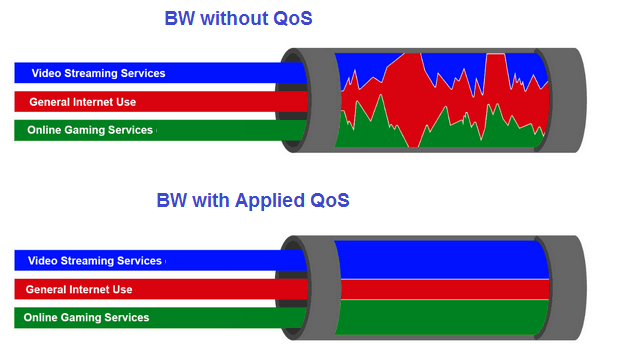
Quality of service (QoS) refer to the measurement of the overall performance of a service experienced by the users of the network. To quantitatively measure the QoS packet loss, bit rate, throughput, transmission delay, availability, jitter, etc. related aspects of service are considered. Following figure show the performance of channel Bandwidth (BW) with and without QoS.
5G QoS Identifier in 3GPP
5G QoS Identifier (5QI) values are defined in the 3GPP specification to describe the QoS requirements of traffic for frequently used services in 5G systems. These values specify standardized QoS characteristics for the required packet forwarding treatment between UE and the UPF of 5G Core. Following table describe examples of the standardized 5QIs.
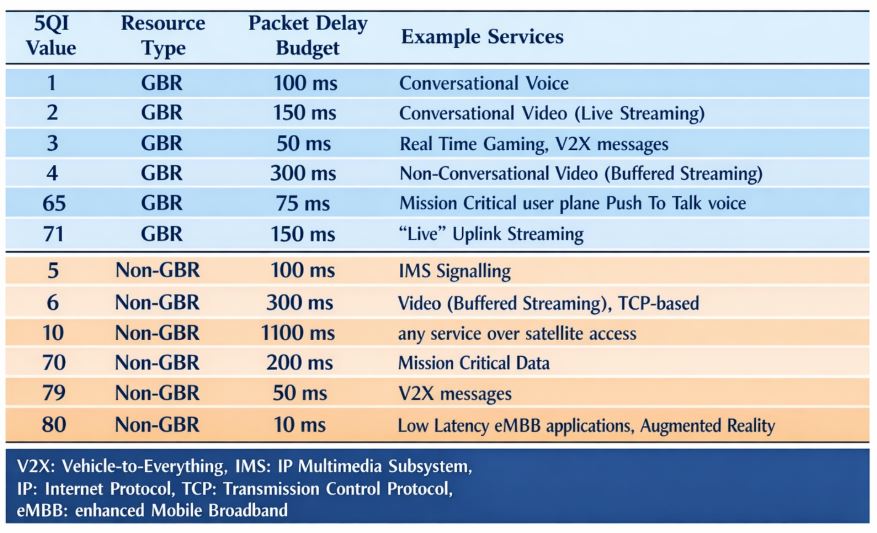
By definition, each 5QI value is mapped to QoS characteristics, e.g., Resource Type, Default Priority Level, Packet Delay Budget, and Packet Error Rate, and their corresponding example services are also specified.
The Resource Type includes Guaranteed Bit Rate (GBR) and Non GBR. The Packet Delay Budget (PDB) defines an upper bound of latency in which a packet may be delayed between the UE and the UPF.
- 5QI 1 is used for “Conversational Voice” (GBR, PDB: 100 ms)
- 5QI 6 is “Video (Buffered Streaming)” (Non-GBR, PDB: 300 ms)
- The first NTN-related 5QI was introduced as 5QI 10 with a PDB of 1,100 ms in 3GPP Release 17.
These identifiers enable 5G systems to recognize traffic characteristics and allocate resources accordingly.
5QI-10 for NTN
The QoS selection depends on the service offered and the maximum delay offered by network. The NTN network serves from three main constellations (LEO, MEO and GEO) having very large distance b/w NTN based base station and UE, which result in the very high propagation delay as shown in following table.
| Orbit Type | Approximate Altitude | Typical One-Way Delay |
|---|---|---|
| LEO | 500–2000 km | 20–40 ms |
| MEO | 2000–20000 km | 100–150 ms |
| GEO | ~35786 km | ~250 ms |
Considering above the round-trip delay in GEO systems can exceed 500 ms, which impacts real-time applications such as voice & video calls, remote control systems, and etc.
With this much delay the existing 5QI can not be used because the maximum packet delay budget (PDB) in GBR 5QI-4 and Non -GBR 5QI -6 is 300ms. Hence a new 5QI is introduced with a support of 1100ms PDB
5QI-10 Charterstatics
One notifiable aspect of 5G is the strong and sophisticated quality of service (QoS) framework that defines different QoS flows and introduces a specific protocol (SDAP) to leverage, maintain and manage the QoS support.
This framework stays unchanged, with small enhancements, particularly by the definition of additional QoS service classes tolerating the extended end-to-end delays which in many cases might be beyond what is today allowed by the standardized 5G QoS classes. Especially the packet delay budget in the case of a GEO constellation leads to the introduction of the 5QI value of 10 in [TS 23.501] where the delay budget is extended to 1100 ms.
5QI -10 QoS profiles details are shown in following table.
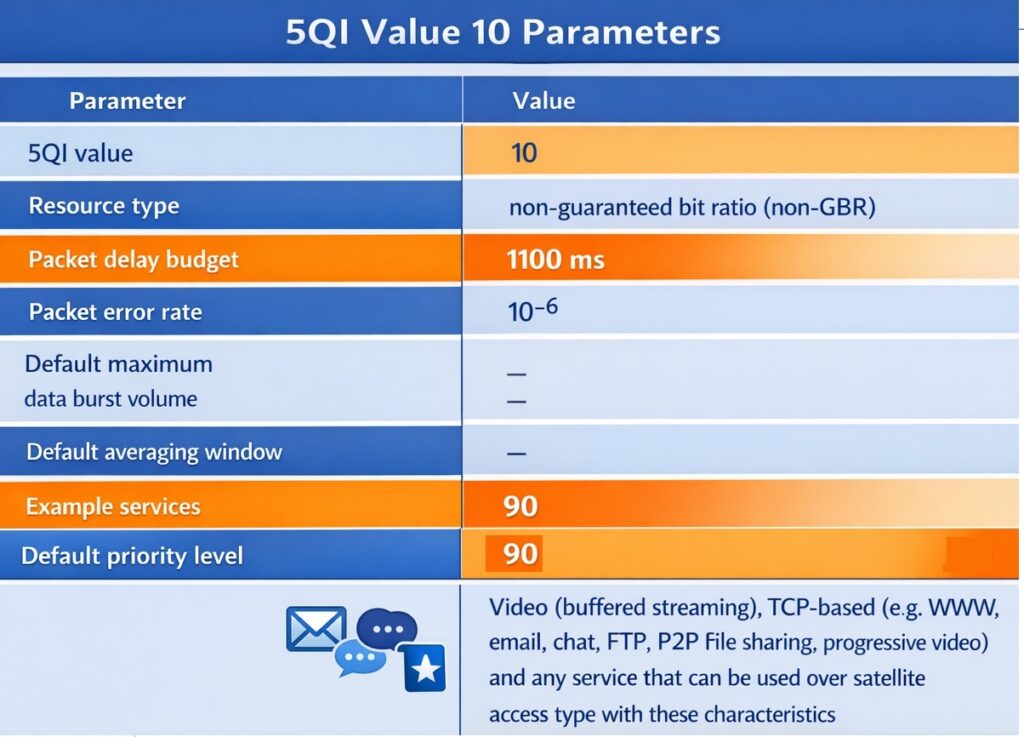
How the new 5QI is configured
3GPP proposes the introduction of new types of the Information Element (IE) RAT type, to support different QoS profiles and QoS flows that possibly differ from QoS profiles that are possible in terrestrial RAN.
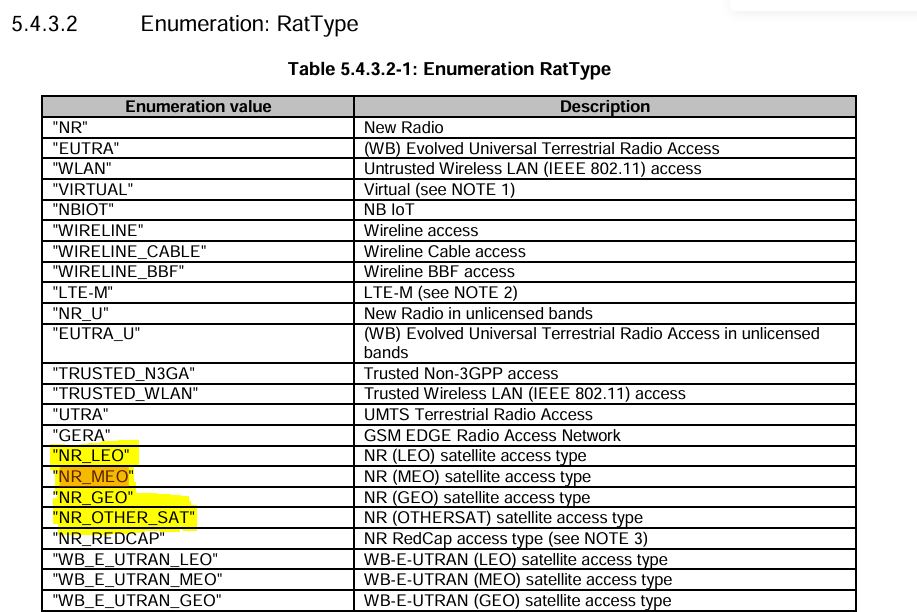
The new Information Element (IE) RAT type is part of the gNB ID within the global RAN node ID. For this existing values are “NR” and “LTE”, and addition values such as “NR (LEO)”, “NR (MEO)”, “NR (GEO)” and “NR (OTHERSAT)” is suggested.
With this RAT type, the core network functions e.g. AMF and SMF may select and configure the most appropriate RAN for a given QoS request. A possible amendment to the existing concept requests the notification of the policy control function (PCF) and the application function (AF) about the use of satellite access or satellite backhaul, to inform services about a potential longer RTT. Services that require a short delay, like URLLC, will probably avert the usage of NTN connectivity if possible.
The 3GPP system today has significant possibilities for differentiated charging control function (CHF) and PCF, e.g. it is possible to offer 5G connectivity services over a non-3GPP RAT like Wi-Fi. Under discussion is whether this methodology is to be extended to allow a differentiation between terrestrial NR and NTN, e.g. LEO or GEO, as they offer a different service profile.
The proposal, as mentioned before, is to introduce the new radio access technology (RAT) types value. This allows 5GC network functions for session management (SMF), PCF, CHF as well as the service layer (e.g. AF) to be aware of when the UE is using satellite access. The long delays that result due to satellite based communications require the extension of existing timers for mobility and session management in order to avoid a connection timeout due to pending response messages.
References
- Docomo White Paper
- 3GPP TS 23.501, System Architecture for the 5G System, Release-17.
- 3GPP TR 38.811, Study on NR to Support Non-Terrestrial Networks.
- 3GPP TR 38.821, Solutions for NR to Support NTN.
- Lin et al., 5G from Space: An Overview of 3GPP Non-Terrestrial Networks.
Related Post
- 3GPP Frequency Bands for 5G Satellite Communication
- NTN RACH Procedure Impacts – NTN RACH
- System Information 19 – SIB19 For 5g Satellite NTN
- SpaceX – Starlink System Architecture for Internet
- Direct to Cell Satellites – SpaceX Cell Tower