
What Is AI Security? A Complete Guide for Security Teams
Artificial intelligence is now embedded in products, workflows, and security tools alike, and that spread has opened a new front for attackers. For teams new to the topic, the short answer is that this discipline protects AI systems and governs how AI is used across an organization. It matters because the risks are already real: IBM’s 2025 Cost of a Data Breach Report found that 13% of organizations had suffered a breach of their AI models or applications, and 97% of those lacked basic AI access controls. In short, the tools are spreading faster than the safeguards meant to contain them. As more businesses invest in robust generative ai development services to scale their operations safely, this guide defines the field, maps the threats, walks through the frameworks that give it structure, and lays out the practices security teams can put to work today.
Key Takeaways
- AI security guards AI systems while also using AI to strengthen an organization’s defenses.
- It tackles threats that older tools miss, such as prompt injection and data poisoning.
- Frameworks from NIST, OWASP, and MITRE give teams a shared structure and language.
- IBM found that 97% of AI-related breaches involved missing access controls.
- Used well, AI in defense cuts breach costs by nearly 1.9 million and speeds up containment.
AI Security, Defined
AI security is the practice of protecting artificial intelligence systems, their training data, models, and pipelines, from attack, while governing how people and applications use AI so sensitive information stays controlled. In plain terms, it keeps the AI you depend on from being turned against you. Teams that want what AI security really means spelled out often begin with a clear definition before choosing any tools. The definition sets scope, and whatever gets left out tends to be where the next incident appears.
The field has two sides that are easy to confuse.
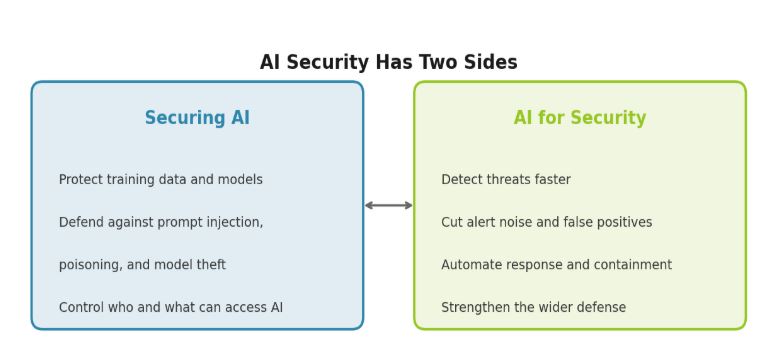
A complete program treats defending AI and defending with AI as one effort.
The first is security for AI: defending models and data from tampering, theft, and misuse. The second is AI for security: using machine learning to spot threats and respond faster. Leaving out either half creates a blind spot. Most teams inherit both challenges at once: models they must defend, and AI-powered tools they increasingly lean on to defend everything else.
Why AI Security Is Different
Traditional cybersecurity guards networks, endpoints, and applications with rules and signatures. AI breaks that mold. Models learn from data, produce probabilistic outputs, and can be steered by carefully crafted inputs, so a system can be compromised without a single line of malicious code.
That shift matters for anyone already protecting data across networks, because the data feeding a model is now part of the attack surface. When AI-driven network automation makes real decisions, the integrity of the model behind it becomes a security concern, not merely a performance one. A poisoned dataset or a manipulated prompt does not trip the alarms built for malware, so AI needs controls of its own. The good news is that many core security habits still apply; they simply have to reach the model layer as well.
The AI Security Threat Landscape
AI introduces attacks that have no equivalent in traditional defense. A handful account for most real-world incidents.
| Threat | How it works | First line of defense |
|---|---|---|
| Prompt injection | Hidden instructions hijack a model’s behavior | Input filtering and output checks |
| Jailbreaking | Crafted prompts bypass safety guardrails | Hardened system prompts and testing |
| Data poisoning | Tampered training data corrupts the model | Data validation and provenance |
| Model extraction | Repeated queries clone a model or its data | Rate limits and access controls |
| Sensitive data leakage | Confidential input resurfaces in AI output | Data classification and redaction |
| Warning: many of these succeed for a mundane reason. In IBM’s data, 97% of organizations breached through AI had no proper access controls, meaning the door was simply left open. |
Cataloging adversary techniques is the purpose of resources such as the MITRE ATLAS knowledge base, which security teams use to model AI-specific attacks before they happen. The pattern across these threats is that they target the model and its data rather than the perimeter, so defenses have to move closer to the AI itself. Knowing which attack you actually face is the first step toward blocking it.
Many generative AI development services help businesses build intelligent, scalable solutions powered by advanced AI models.
Frameworks That Give AI Security Structure
No team should build controls from a blank page. Several established frameworks provide a shared language and a tested starting point.
| Framework | What it covers |
|---|---|
| NIST AI Risk Management Framework | Governing AI risk through the functions govern, map, measure, and manage |
| OWASP Top 10 for LLM Applications | The most common risks in language-model applications |
| MITRE ATLAS | A catalog of real adversary techniques used against AI |
| Google’s Secure AI Framework | Secure-by-design controls for building and running AI |
| Secure AI development guidelines | A lifecycle approach from design through operation |
For a government-backed baseline, security teams increasingly follow internationally agreed security guidelines that were co-authored by more than twenty national cyber agencies and organized around the full AI lifecycle.
“Security is not a postscript to development but a core requirement throughout.” Lindy Cameron, National Cyber Security Centre
No single framework does everything. Most teams pair a governance model with a technical threat list and an adversary catalog, then adapt the mix to their own stack. Crosswalks between them mean adopting one rarely locks a team out of the others. The aim is coverage, not collecting frameworks for their own sake.
Best Practices for Security Teams
Frameworks point the way; these practices turn them into daily action.
- Inventory every AI system, model, and tool in use, including the unsanctioned ones.
- Put least-privilege access around models, data, and AI agents, treating each as an identity.
- Protect the data pipeline end to end, from training sets to live prompts.
- Red-team models regularly for prompt injection, jailbreaks, and data leakage.
- Monitor AI activity and rehearse an incident response plan built for AI.
Access is the highest-leverage of these. Because so many incidents trace back to open access, applying a zero-trust access model to AI systems closes the most common gap. The same rigor used when securing connected devices extends naturally to models and the agents that run them. Governance ties it all together, since a named owner, a written policy, and a set review date keep the other practices from quietly lapsing.
| Key stat: the upside is concrete. Organizations that use AI extensively in their own defenses save close to 1.9 million dollars per breach and contain incidents about 80 days faster, according to IBM. |
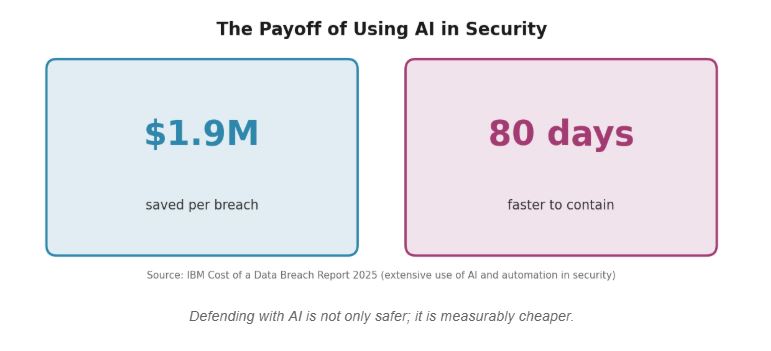
Defending with AI is not only safer; it is measurably cheaper.
[Video: “Understanding AI Agent Security: Safeguard LLM Systems Effectively” by IBM: https://www.youtube.com/watch?v=SAYmsKxNDF4]
This short explainer covers how to safeguard the language-model systems and agents that a modern program has to protect. As autonomous AI agents at the edge take on more decisions, these habits only grow more important. Treated as routine, none of this is exotic; it is disciplined security applied to a new kind of system.
| Pro tip: fold AI security into the risk reviews you already run rather than standing up a separate process. Shared ownership across security, data, and compliance teams is what keeps it alive. |
Frequently Asked Questions
What does AI security mean in simple terms?
AI security is protecting AI systems and their data from attack while controlling how the technology is deployed. It covers both defending models from threats like prompt injection and using AI to bolster the organization’s wider defenses.
Does AI security just mean using AI in cybersecurity?
Not quite. That defensive use is only one half. The other half is securing the AI systems themselves. A complete program covers both, since strong detection tools help little if the models behind them are exposed.
What are the biggest AI security threats?
Prompt injection, jailbreaking, data poisoning, model extraction, and sensitive data leakage top most lists. They exploit how models learn and respond, which is why traditional firewalls and antivirus rarely catch them.
Which framework should we use?
Many teams combine the NIST AI RMF for governance with OWASP’s list for application risks and MITRE ATLAS for adversary techniques. The right mix depends on whether your priority is policy, engineering, or threat modeling.
Where should a security team start?
Start with an inventory of every AI system in use, then apply strict access controls. Since most AI breaches involve missing controls, visibility and least-privilege access deliver the fastest risk reduction.
AI Security Is Now Core Work
AI security is no longer a specialist niche; it is becoming a core part of every security team’s remit. The field is broad, covering the models you build, the tools you buy, and the AI now woven into your own defenses, yet it is far from unknowable. Define what you are protecting, learn the threats that target AI specifically, adopt a proven framework, and lock down access first. None of those steps require exotic tooling; they reward attention and follow-through. The organizations that treat this as a discipline rather than an afterthought will be the ones free to use AI with confidence.
References
- NCSC and CISA, Guidelines for Secure AI System Development, 2023.
- NIST, Artificial Intelligence Risk Management Framework (AI RMF 1.0), 2023.
- IBM, Cost of a Data Breach Report 2025. https://www.ibm.com/reports/data-breach
- MITRE, ATLAS (Adversarial Threat Landscape for Artificial-Intelligence Systems).
- Google, Secure AI Framework (SAIF). https://saif.google/
- Fact Check: All statistics and data points in this article were verified against original sources as of July 6, 2026. Sources are listed in the References section.