


Introduction
To make NTN network to work, it requires an update and amendment of certain protocols and procedures to take care challenges like large propagation delay, Doppler shift, beam mobility and wide coverage over countries border etc. 3GPP performed a number of studies to investigate and find out the possible modifications and corrections within existing base line 5G NR protocol structure and its procedures.
NR-NTN (Non-Terrestrial Network) protocol stack maintained the same PHY, MAC, RLC, PDCP, and SDAP layers while modifying them to handle high latency and Doppler shifts. Here major changes include expanded timers, new HARQ mechanisms, and increased timing advance for satellite movement, with RRC signaling enhanced to include ephemeris data.
This blog post provides an overview of the most relevant procedures with a short presentation of potential countermeasures.
Key Pointers for NTN Protocol Stack
- NAS Layer has to adapt Mobility Management and PDU Session management procedures to support cross-country coverage and NTN RAT Type for QoS Configuration
- RRC Layer has to adapt to idle-mode and connected-mode signaling and procedures e.g. broadcast of system information (SIB), registration, paging, ephemeris information, location information, measurement configuration, RRM for scheduling and handover procedures.
- SDAP layer is not effected by NTN, expect configuration of new QoS profiles
- PDCP layer has to adapt discardTimer, t-Reordering timer, and Sequence Numbering. New IE discardTimerExt is also introduced for future needs
- RLC Layer need to adapt maxRetxThreshold, t-PollRetransmit, t-Reassembly, t-statusProhibit timers. A new IE t-ReassemblyExt is also introduced for future needs
- MAC enhancements are required for procedures like RACH, DRX, TA, SR and HARQ.
- Physical layer will use OFDMA, new enhancements include FDD duplex operation for both FR1 and FR2, preferred MCS choices is QPSK and 16QAM, optionally 64QAM


NTN Protocol Stack
3GPP has aim to introduce NTN technology with minimal changes to the existing system architecture. To achieve this, 3GPP has conducted several discussions to determine how the current 5G protocol structure could be adapted.
The physical layer must handle new challenges such as long propagation delays and Doppler effects. Possible updates were also studied for other protocol layers, which includes MAC, RLC, PDCP, and SDAP. In addition, 3GPP introduced certain adaptations and extensions in the RRC and NAS layers to optimize signaling for NTN operations.
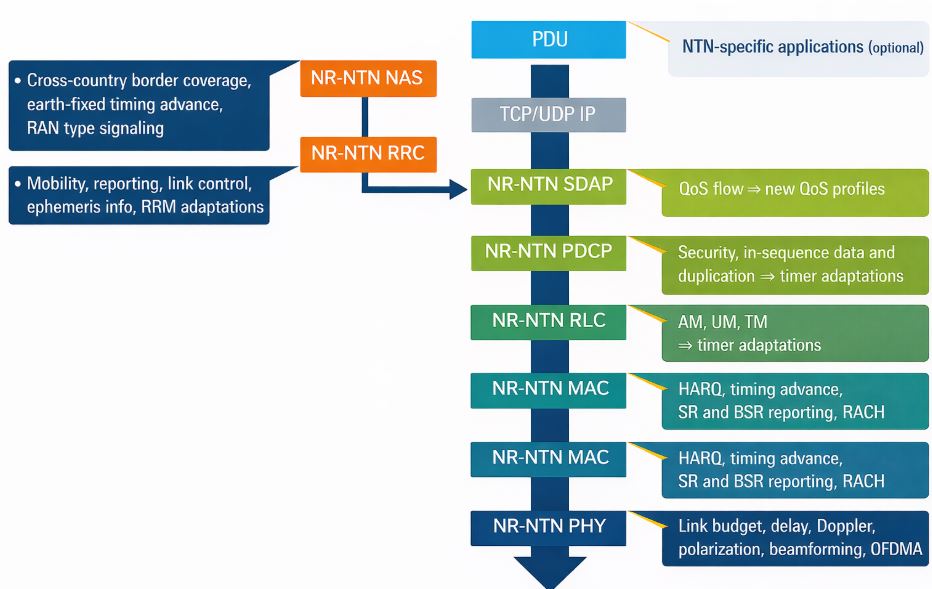
The end to end NTN protocol structure for control and user plane is depicted in following picture.

NTN-NAS Layer
NAS (Non-Access Stratum) layer is the highest layer in the control plane protocol stack between the UE and the Core Network. It perform mobility management (registration) and session management (PDU session establishment) procedures.
Specific to NTN, the major impacts on the NAS layer is to support NTN cross-border coverage. The large coverage across boarder include broadcasting multiple PLMN and thus current NAS signaling needs to adapt NAS PLMN selection process and also needs to incorporate adjustments in registration setup to the longer RTT.
Another support is required for the definition of a new value RAT type that is signaled to the AMF, informing the core network functions about the UE and service data flow will use an NTN connection and therefore longer RTT needs to be considered for QoS Configuration.
NTN-RRC layer
RRC – Radio Resource Control is layer 3 control plane protocol which manage procedures like idle-mode and connected-mode procedures and signaling.
With respect RRC signaling adaptations to support NTN, it has to update idle-mode and connected-mode signaling and procedures. These signaling and procedures includes broadcast of system information (SIB), registration, paging, use of satellite ephemeris information, location information, measurement configuration (meas object), RRM for scheduling, link adaptation, MCS control and handover procedures.
To acquire a NTN cell, a new SIB e.g. SIB19 is introduced that provides information on aspects like ephemeris, common timing advance parameters, validity info for UL synchronization, cell stop info, cell reference location and epoch time. When the UL synchronization info expires, the UE needs to acquire the SIB once again. Mobility between two satellites is supported by RRM procedures.
Another requirement is One flexible configuration of RRM-related measurement procedures, like the SMTC windows. In 3GPP Release 17, one or more SMTC configurations associated with one frequency can be configured and optionally linked to a set of cells.
NTN SDAP layer
The SDAP layer is responsible for the mapping between QoS flows and data radio bearers. In NTN, It is not affected by the large round-trip delays. As of larger RTT, 3GPP introduces new QoS profiles 5QI value 10 tolerating such longer delays. For the SDAP, it was found that it is not necessary to introduce any modifications to support NTN.
NTN PDCP layer
PDCP is an user plane protocol layer which supports data transmission with in-sequence provisioning, discard functions, dispatching, ciphering and duplication. Following new adapation has been study by 3GPP
- With respect to NTN, No need to update the ciphering functions
- This layer needs to cope with longer RTT to provides the QoS support in close cooperation with the RLC layer.
- PDCP parameter discardTimer sets the maximum time before a discard notification is sent to the TX RLC entity and, in the case of extended retransmissions, there is a suggestion to extend this timer as a beneficial amendment.
- In 3GPP release 17, a new IE discardTimerExt with length 2000 ms is introduced with the option of future extension
- At the RX entity, the t-Reordering timer influences the reordering function. The maximum duration of currently 3000 ms is surely sufficient for RLC UM mode, but assuming a larger number of RLC AM retransmissions a probable extension of this timer value could be beneficial.
- As with the RLC layer, a potential extension of the PDCP sequence number, currently max. 18 bit, and the buffer size given as Window_Size would be beneficial to NTN.
There is no direct need for such a modification, but future scenarios supporting shorter slot durations with higher subcarrier spacing and carrier aggregation scenarios may profit from such amendments to avoid stalling situations.
NTN RLC layer
RLC- Radio Link Control layer is responsible for Segmentation/Reassembly, Error Correction in AM mode, Sequence Numbering and Duplicate Detection to discards packets. With respect to NTN following points are considered for adaptation to cope with the major challenge of extended RTT to work in all the three transport modes UM, AM and TM.
- With extensive delays, AM mode requirements are difficulty to meet and we can not escape as the RLC AM is the default mode for signaling radio bearers. In this cases, the MAC layer probably needs to operate in HARQ disabled mode and the RLC AM should then ensure reliable data transfer.
- RLC needs a thorough configuration of the maxRetxThreshold parameter that sets the no. of maximum retransmissions and a bridge between the latency and reliability aspect in the QoS profile.
- In AM mode, the RLC layer uses a polling mechanism, where TX entity sends a PDU containing a poll request and starts the timer t-PollRetransmit. The RX entity replies with a status report and, in the case of timer expiry, the poll is repeated. The current configurable maximum time of the t-PollRetransmit timer is 4000 ms, which is considered to be long enough even for NTN GEO RTT.
- The flow control of received data units is controlled by the t-Reassembly timer, with a maximum of 200 ms. This timer detects a possible loss of RLC PDUs at lower layers. Initial proposals indicate that there is no need for an update as the situation is no different from conventional networks.
- Especially in cases where the HARQ is enabled on the MAC layer, an extension will be beneficial because a running t-Reassembly timer also includes HARQ retransmissions.
- 3GPP working group RAN2 suggests an extension up to 2200 ms for reassembly timer and to be future proof an additional t-ReassemblyExt information element (IE) is part of Release 17.
- The t-statusProhibit timer whose length of 2400 ms is considered to be long enough, also for NTN.
- A proposal suggests, a possible extension of the RLC sequence number field, which currently has a maximum length of 18 bits, and extension of the AM_Window_Size describing the buffer status.
- These two values are considered to fulfill the requirements for NTN as well, but future technology evolutions may support larger subcarrier spacings (e.g. 120 kHz) and therefore shorter slot durations as well as methodologies like carrier aggregation or dual connectivity which could then lead to a stalling situation as the buffer will be exceeded.
NTN MAC layer
MAC layer procedures also affected by a longer latency. In current 3GPP ggreed conclusions includes the MAC enhancements for procedures like random access (RACH), power saving or discontinuous reception (DRX), timing advance (TA), scheduling request (SR) and hybrid automatic repeat request (HARQ).
- HARQ feedback can impact on reliability results. In the recommendation, these reliability issues are taken care using a more robust MCS selection and with the support of higher layers like RLC and PDCP.
- RACH extensions ensure proper functioning under circumstances resulting from longer delays.
- Timing advance updates deal with not only the absolute value of the longer RTT but also mitigate affects like time-variant and floating RTT due to the elliptic nature of the beam footprint and satellite motion.
Physical layer
For NTN support, the major impacts are on the physical layer. The impacts are due the long delays, the Doppler shift, high path attenuation and the polarization rotation.
- The physical waveform does not require changes due to NTN. It is decided by 3GPP to use OFDMA as the primary waveform.
- New frequency bands are possible in the 5G system and slight changes like a higher transmit power, circular polarization introduction or sophisticated beamforming methodologies do not require an intensive specification update
- NTN Physical layer will reuse the existing reference signals and physical channel structure
- Physical layer can use FR1 and FR2 spectrum for NTN.
- The duplex mode is FDD applied for NTN. A TDD system needs a guard period between the TX and RX switch. Due to the long delays in NTN, such a guard period would need to be very long and result in inefficient spectrum use. So 3GPP decided on FDD for the FR2 frequencies in NTN, where as traditional FR2 bands are all TDD. The required adaptations of the existing specifications to permit FDD also in FR2.
- Synchronization and initial network acquisition, remains same using synchronization signals and channels e.g. the SSB block in NTN.
- For cell selection, UE will follow the S-criterion, determining the best cell by measuring power e.g. RSRP and signal quality e.g. RSRQ.
- For cell reselection purposes, the ephemeris information and the UE location can be considered.
- NTN preferred modulations schemes choices is QPSK and 16QAM, optionally 64QAM can be used
- Due to the longer RTT, link quality feedback e.g. CQI may arrives delayed at the gNB scheduler
- NTN MIMO is left for future enhancements because multiple antenna technologies (MIMO) in NTN may suffer from the dominant LOS and long distance results in delayed rank indicator feedbacks.
References
- 3GPP TS 23.501, System Architecture for the 5G System, Release-17.
- 3GPP TR 38.811, Study on NR to Support Non-Terrestrial Networks.
- 3GPP TR 38.821, Solutions for NR to Support NTN.
- Lin et al., 5G from Space: An Overview of 3GPP Non-Terrestrial Networks.