


Introduction
For centuries, oceans, forests, and remote regions remained disconnected from mainland telecommunication networks. Distance, terrain, and lack of infrastructure made reliable connectivity nearly impossible.
Today, the reality is changing with advances in satellite-based communication. The introduction of Non-Terrestrial Networks (NTN) in 3GPP Release 17 marks a major turning point, allowing satellites to integrate seamlessly with traditional terrestrial cellular networks. As a result, the long-standing divide between land-based mobile coverage and satellite communication is fading, bringing reliable connectivity to even the most remote corners of the world.
Following two major 3GPP technologies are leading this transformation:
- NB-IoT NTN (Narrowband IoT)
- NR NTN (5G New Radio)
Narrow Band NTN – NB NTN
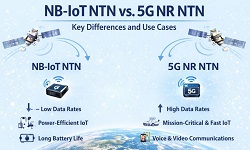
NB NTN also known as Narrow Band IoT over Satellite. This is an evolution of Narrowband IoT (NB-IoT) technology from ground based terrestrial networks to satellite based Non-terrestrial networks. It is highly power-efficient, allowing devices to run for years on a single battery. It is best for non-real-time data like soil moisture monitoring in agriculture or location tracking for shipping containers in the middle of the ocean.
Key Features of NB- NTN
- It is based on LTE release 13 NB-IOT and further enhanced to support satellite networks
- Downlink is OFDM and Uplink is SC-FDMA
- Subcarrier Spacing – 15KHz
- Supported Bandwidth – 180 KHz
- Stand-alone Operation – in-band and guard band
- Most useful feature for NB-NTN includes
- PSM (Power Saving Mode)
- eDRX (Extended Discontinuous Reception)
- Long sleep cycles (hours/days)
- NB-NTN is supported 3GPP release 17 onwards
- Payload architecture – Transparent payload
- No Mobility – handover support
- Supported orbits – LEO, MEO and GEO
NB- NTN Use Cases
Service providers and enterprises are considering NB-NTN as a cost-effective connectivity solution for remote and hard-to-reach locations. This satellite-based IoT communication is enabling a reliable, low cost solution, where terrestrial cellular networks are unavailable, impractical, or too expensive to deploy.
With its ability to deliver wide-area coverage, long battery life, and low data transmission costs, NB-NTN is emerging as a preferred technology for following uses.
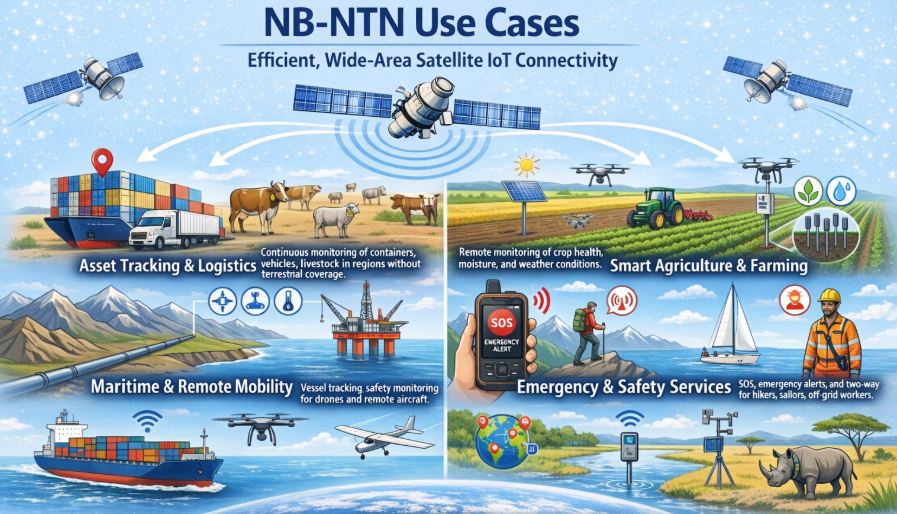

- Asset Tracking & Logistics: It can be used for continuous monitoring of assets, such as shipping containers, livestock, or vehicles transported through regions do not have terrestrial n/w coverage.
- Agriculture and Farming: In remote, rural areas where we do not have cellular n/w, NB-NTN can help in remote monitoring of crop health, soil moisture, weather conditions and livestock tracking.
- Infrastructure Monitoring: NB-NTN can also be used to monitor critical infrastructure assets like pipelines, oil rigs, and power grids in isolated areas.
- Emergency & Safety Services: Hikers, sailors, or off-grid workers can make used of NB-NTN for SOS, emergency alerts, and two-way messaging.
- Maritime & Remote Mobility: It can also be used tracking and safety monitoring for vessels, drones, and aircraft.
- Environmental Sensing: Remote data collection for flood monitoring, weather stations, and wildlife conservation can also be done using NB-NTN.
New Radio NTN – NR NTN
NR NTN is also know as 5G over Satellite. It uses 3GPP New Radio (NR) technology air interface. It is designed to provide “direct-to-cell” connectivity, which means a standard 5G smartphone can connect directly to a satellite for voice/video calls, messaging, or internet in areas where no traditional cell tower coverage. It also supports Fixed Wireless Access (FWA) for remote homes, ships, forest and mountains.
Key Features of NR- NTN
- Its baseline technology is 5G New Radio (NR) enhanced to support satellite networks
- Downlink and Uplink is CP-OFDM
- Subcarrier Spacing – 15KHz, 30 KHz
- NR-NTN is supported 3GPP release 17 onwards
- Payload architecture – Regenerative payload
- Supported Bandwidth
- FR1 – Sub-6 GHz) NTN band also know as ITU L/S Band, supports 5, 10, 15, 20, 25, 30, 35, 40, and 50 MHz channel bandwidths
- FR2 also known as ITU- Ka/Ku Bands supports significantly higher bandwidths, up to 400 MHz or more
- Supported Operation – Standalone, Carrier Aggression, Dual Connectivity
- Mobility support – NTN to NTN Handover and NTN to TN
- Supported orbits – LEO, MEO and GEO
NR-NTN Use Cases
NR NTN is more useful for the Use Cases which requires high data rates and Low-Latency. Following are major uses cases under consideration in the industry.
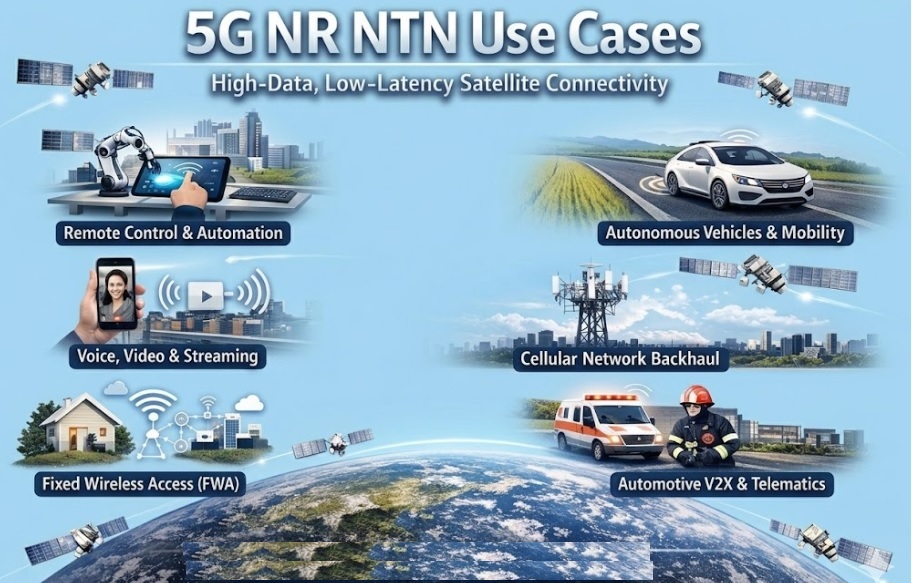

- Remote control and automation: 5G NR NTN low latency and high data rates make it suitable for industrial automation and remote operations. We can use it for real-time control of machines, robots, and autonomous systems where traditional cellular network coverage can not reach.
- Autonomous vehicles and mobility: NR NTN supports autonomous driving functions by providing reliable connectivity beyond terrestrial coverage. This is critical for vehicles operating in remote or rural areas.
- Voice, video, and media streaming: Supports voice calls, video conferencing, and media streaming is available with NR NTN, where user experiences could be similar to terrestrial 5G networks.
- Cellular network backhaul: Telecom operators can use NR NTN to backhaul cellular traffic in regions with limited or no fiber infrastructure. This is especially useful for extending coverage to underserved areas.
- Fixed Wireless Access (FWA): NR NTN enables FWA services in locations without sufficient cellular coverage, offering broadband connectivity where traditional networks are unavailable.
- Public safety and disaster response: NR NTN supports mission-critical communications for emergency services. When terrestrial networks fail during disasters (flood, tsunami, earth-quack) responders can rely on satellite-based connectivity.
- Automotive V2X and telematics: The technology enables V2X communications, advanced telematics, and autonomous vehicle development, ensuring essential vehicle services are available anywhere.
- Global connectivity and coverage extension: NR NTN fills gaps in cellular and fiber infrastructure, delivering cost-effective, energy-efficient global coverage to regions that terrestrial networks cannot reach.
NB-NTN vs NR-NTN: Key Differences
| Feature | NB-NTN | NR-NTN |
|---|---|---|
| Data Rate | Low | High |
| Device Type | IoT sensors | Smartphones, CPE |
| Power Consumption | Very Low | Moderate |
| Bandwidth | Narrowband | Wideband |
| Use Case | Massive IoT | Broadband & voice |
| Complexity | Low | High |
Conclusion
NB-NTN and NR-NTN represent a transformative step in extending 5G beyond terrestrial boundaries into space. By addressing challenges such as Doppler shift, long propagation delays, and link budget constraints, 3rd Generation Partnership Project Release 17 and 18 have enabled standardized satellite-cellular integration. NB-NTN powers massive low-power IoT connectivity, while NR-NTN unlocks broadband and direct-to-device satellite services. Together, they form the technological foundation for a truly global, space-integrated 5G ecosystem.
References
- 3GPP TR 38.821: Solutions for NR to Support Non-Terrestrial Networks (NTN), Release 16/17
- 3GPP TS 38.300: NR; Overall Description; Stage-2, Release 17/18
- 3GPP TS 38.211: NR; Physical Channels and Modulation, Release 17
- 3GPP TS 38.213: NR; Physical Layer Procedures for Control, Release 17
- 3GPP TS 38.214: NR; Physical Layer Procedures for Data, Release 17.
- 3GPP TR 36.763: Study on NB-IoT/eMTC Support for Non-Terrestrial Networks, Release 17.