
What Is SSL Encryption and How Does It Work?
SSL Introduction
In modern life, the internet has become the backbone —banking, communication, shopping, cloud services, and enterprise applications all depend on it. However, the internet itself was never designed to be secure. Data exchanged over public networks can be intercepted, modified, or stolen unless without proper protection.
This is where SSL encryption plays a critical role.
SSL (Secure Sockets Layer), which is now technically replaced by TLS (Transport Layer Security), is the fundamental security technology that enables safe and encrypted communication over the internet. In this blog, we will explore what SSL encryption is, why it is important, and how it works step by step, with deep technical clarity.
What Is SSL Encryption?
SSL encryption is a cryptographic protocol which secures the data exchanged between two systems a client and the server—most commonly a web browser (client) and a web server. It ensures that sensitive information such as login credentials, personal data, and payment details cannot be read or altered by attackers while in transit.
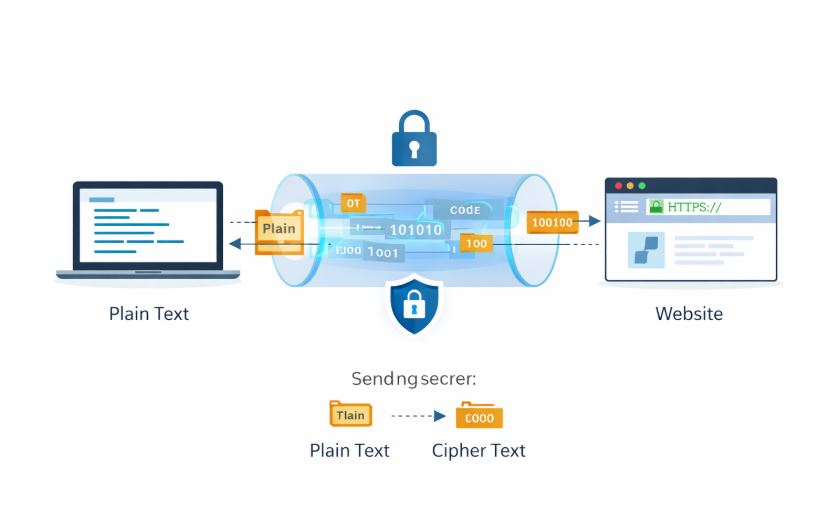
When SSL is enabled on a website:
- The website URL uses HTTPS instead of HTTP
- A padlock icon appears in the browser
- Data is encrypted end-to-end between client and server
Although the term SSL is still widely used, modern browsers and servers actually use TLS (Transport Layer Security). SSL is officially deprecated, but the name remains popular for simplicity.
Why Is SSL Encryption Important?
Without SSL encryption, data travels over the internet as plain text, making it extremely vulnerable to cyber threats.
Risks of Not Using SSL
- Man-in-the-Middle (MITM) attacks
- Packet sniffing on public Wi-Fi
- Password and session hijacking
- Data manipulation and injection attacks
- Loss of user trust and credibility
Benefits of SSL Encryption
- Protects sensitive user data
- Authenticates the identity of websites
- Ensures data integrity
- Improves search engine rankings (SEO)
- Required for compliance (PCI-DSS, GDPR, etc.)
In fact, modern browsers like Chrome and Firefox explicitly mark non-HTTPS websites as “Not Secure.”
Core Security Principles of SSL
SSL encryption is built on three foundational security pillars:
- Confidentiality: Data is encrypted so that only the intended recipient can read it.
- Authentication: SSL certificates verify that users are communicating with the legitimate server, not an imposter.
- Integrity: Cryptographic checks ensure that data is not altered during transmission.
How SSL Encryption Works (Step-by-Step)
SSL works using a process known as the SSL/TLS Handshake, which establishes a secure session before any actual data exchange.
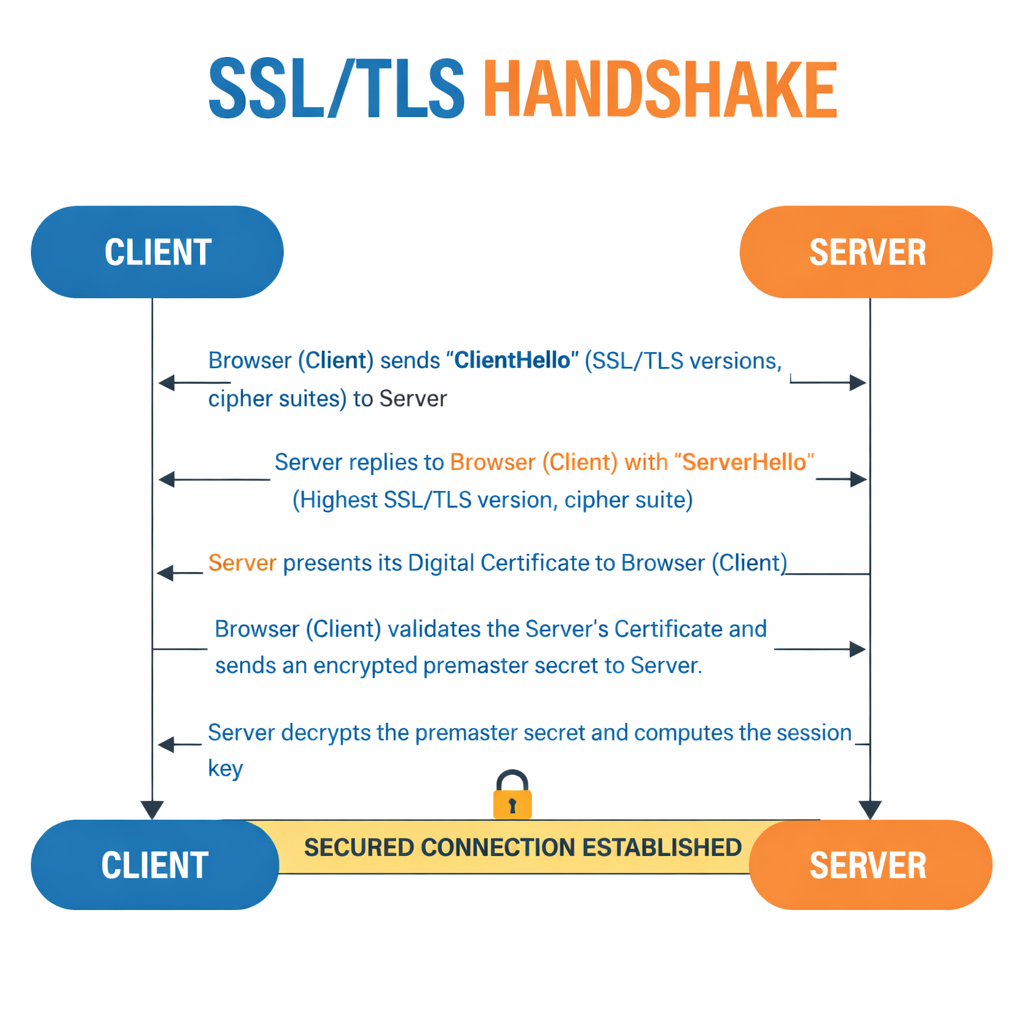
Step 1: Client Hello: When a user visits an HTTPS website, the browser sends a Client Hello message containing:
-
- Supported TLS versions
- Supported cipher suites
- A randomly generated number (Client Random)
This message is sent in plain text.
Step 2: Server Hello and Certificate Exchange: The server responds with:
-
- Selected TLS version
- Selected cipher suite
- Server Random number
- SSL Certificate
- The SSL certificate includes:
- Server’s public key
- Domain name
- Certificate Authority (CA) signature
- Validity period
Step 3: Certificate Validation: The browser verifies the certificate by checking:
-
- Whether the issuing CA is trusted
- Certificate expiration
- Domain name match
- Certificate revocation status
If verification fails, the browser warns the user of a security risk.
Step 4: Key Exchange: The browser generates a session key for symmetric encryption. Depending on the cipher suite:
-
- RSA
- Diffie-Hellman (DHE)
- Elliptic Curve Diffie-Hellman (ECDHE)
The session key is encrypted using the server’s public key and sent to the server. Only the server can decrypt it using its private key.
Step 5: Secure Encrypted Communication: Once both sides share the same session key:
-
- All communication is encrypted
- Data is protected from eavesdropping
- Secure session begins
- This completes the SSL handshake.
Common SSL/TLS Cryptographic Algorithms
SSL combines two types of cryptography:
- Asymmetric cryptography is used for Key exchange, it is secure but slower. Asymmetric encryption is computationally expensive, so it is only used during the handshake. Asymmetric Algorithms includes: RSA, ECDSA and Diffie-Hellman (DHE, ECDHE)
- Symmetric cryptography is used for data transfer, it is fast and efficient. Actual data transfer uses symmetric encryption like AES. AES-128, AES-256, ChaCha20
- Hashing & Integrity includes SHA-256, SHA-384, HMAC
Types of SSL Certificates
Domain Validation (DV)
-
- Verifies domain ownership only
- Quick and free (e.g., Let’s Encrypt)
- Suitable for blogs and informational sites
Organization Validation (OV)
-
- Verifies organization identity
- Displays company details
- Used by business websites
Extended Validation (EV)
-
- Highest level of trust
- Strict verification process
- Used by banks and large enterprises
Where SSL/TLS Is Used Beyond Websites
SSL/TLS secures far more than just web browsing:
-
- Email protocols (SMTP, IMAP, POP3)
- Cloud services and APIs
- VPNs
- IoT communications
- Mobile applications
- 5G core networks and signaling
Frequently Asked Questions (FAQ)
What is SSL encryption?
SSL encryption is a security protocol that encrypts data exchanged between a browser and a server, ensuring confidentiality, authentication, and integrity during online communication.
How does SSL encryption work?
SSL works through a handshake process where the client and server authenticate each other using digital certificates, exchange encryption keys, and establish a secure encrypted session.
What is the difference between SSL and TLS?
SSL is an older, deprecated protocol, while TLS is its modern and more secure replacement. Today, HTTPS connections use TLS, even though the term SSL is still commonly used.
Why is SSL important for SEO?
Search engines like Google prioritize HTTPS websites. SSL improves search rankings, increases user trust, and reduces bounce rates.
What happens if a website does not use SSL?
Browsers label it as “Not Secure,” exposing users to data theft, lowering trust, and negatively impacting SEO and compliance.
Conclusion
SSL encryption is the foundation of secure communication on the internet. By combining authentication, encryption, and integrity, it protects sensitive data from cyber threats and ensures trust between users and websites.
In a world where cyber attacks are constantly evolving, SSL/TLS is no longer optional—it is essential.
No SSL means no security, no trust, and no modern web presence.