


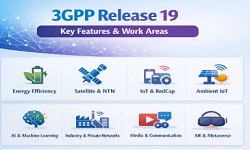
3GPP Release 19
Introduction
3GPP Release 20 and 6G (3GPP Rel-21) journey is started to get pace, the recently concluded Release 19 comes at a clearer view of what the next phase of 5G evolution, so called 5G-Advanced. 3GPP recently published a technical report 3GPP TR 21.919, which offers a consolidated snapshot of the features and work items currently shaping this 19 release.
This report takes a step back and provides accessible summaries of the agreed work items, instead of focusing on detailed specifications. Each summary in this report is the answer two simple questions:
- What problem is being addressed, and
- What impact the feature will have on the overall system.
This makes the study report more valuable not only for specialists involved in standardization work, but also for a large audience trying to keep track of where the industry is moving.
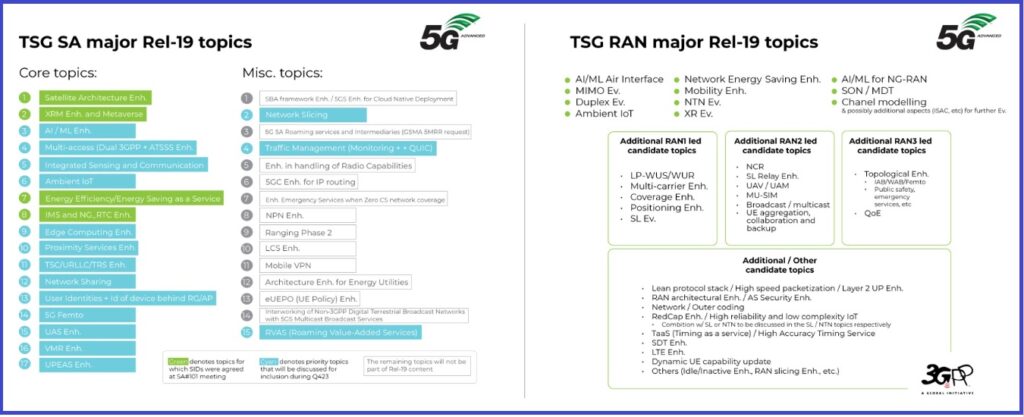

At the time of publication, just over 60 summaries have been included, with many more expected in future updates. Even in its current form, the report clearly shows how wide and diverse the work in 3GPP Release 19 is. It covers many important areas such as improving energy efficiency, enabling satellite-based communication (non-terrestrial networks), using AI in networks, supporting immersive experiences like AR/VR, and developing advanced radio technologies.
We need to keep in mind that the technical report (TR) presents the “initial state” of the Features introduced in Release 19, i.e. as they are by the time of publication of this document. Each Feature is subject to be later modified or enhanced, over several years, by the means of Change Requests (CRs). Below is the list of all topics covered in this report.
3GPP Release 19 Features and Work Items
Rel-19 Energy Efficiency, Energy Saving
- Enhancements of Network energy savings for NR
- Low-power wake-up signal and receiver for NR (LP-WUS/WUR)
- Energy Efficiency as Service Criteria
Rel-19 Satellite (5GSAT), NTN, UAS, Aerial
- Satellite access Phase 3
- Security Aspects of 5G Satellite Access Phase 3
- Charging aspects of satellite access Phase 3
- Non-Terrestrial Networks (NTN) for NR Phase 3
- Enhancements for Air-to-ground network for NR
- Inter-RAT mode mobility support from E-UTRAN TN to NR NTN
- Non-Terrestrial Networks (NTN) for Internet of Things (IoT) Phase 3 (for LTE)
- Introduction of IoT-NTN TDD mode
- Enhanced requirements and test methodology for NR NTN and IoT NTN
- On-demand broadcast of GNSS assistance data
- Uncrewed Aerial System Phase 3
- Support for PWS in Satellite E-UTRAN and Satellite NG-RAN
- Introduction of BDS (BeiDou Navigation Satellite System) B2b Signal in A-GNSS for LTE and NR
- Introduction of A-GNSS support for NavIC (Navigation with Indian Constellation) L1 SPS (Standard Positioning Service) in NR & LTE
- Management Aspects of Rel-18’s NTN Phase 2
- Lower Selection-priority for PLMN Selection
- New LTE band for 5G broadcast for region 3 utilizing a geosynchronous satellite
- Satellite band-related items
- Introduction of Ku bands for NR NTN
- Introduction of additional operating NR bands for HAPS (High Altitude Platform Station)
- Introduction of another NR NTN S-band (MSS band 2000-2020 MHz UL and 2180-2200 MHz DL)
- New NR NTN bands to support Extended L-band and combined MSS L-band and Extended L-band ranges
- Introduction of another IoT-NTN S-band (MSS band 2000-2020 MHz UL and 2180-2200 MHz DL)
Rel-19 Internet of Things (IoT) and Reduced Capability (RedCap) UE
- NR power class 2 RedCap (Reduced Capability) UE in FR1
- NAS layer overhead reduction for data transfer using CP CIoT
- Management Aspects of RedCap features
Ambient power-enabled Internet of Things (IoT)
- Ambient power-enabled Internet of Things (IoT) (SA and CT)
- Charging for Ambient power-enabled Internet of Things
- Security Aspects of Ambient IoT Services in 5G for Isolated Private Networks
- Solutions for Ambient IoT (Internet of Things) in NR
Rel-19 Artificial Intelligence (AI)/Machine Learning (ML)
- AI/ML Model Transfer Phase 2
- Core Network Enhanced Support for Artificial Intelligence (AI)/Machine Learning (ML)
- Application enablement for AI/ML services
- Artificial Intelligence (AI)/Machine Learning (ML) for NR air interface
- Artificial Intelligence (AI)/Machine Learning (ML) for NR air interface
- Enhancements for Artificial Intelligence (AI)/Machine Learning (ML) for NG-RAN
- AI/ML Management Phase 2
- Protocol for AI Data Collection from UPF
Rel-19 Verticals and Non Public Network
- Rel-19 Enhancements of 3GPP Northbound and Application Layer Interfaces and APIs
- SEAL DD (Data Delivery) Phase 2
- Common Application Programming Interface (API) Framework (CAPIF) Phase 3
- Enhanced OAM for management service exposure to external consumers through CAPIF
- Non-Public Network (NPN) security considerations
- Security for PLMN hosting a NPN
- Interconnect of SNPN
- ProSe support in NPN
Rel-19 communications services
- Media Messaging Enhancements
- Terminal Audio quality performance and Test methods for Immersive Audio Services, Phase 2
- EVS Codec Extension for Immersive Voice and Audio Services, Phase 2
- 5GMSG Service phase 3
- Video Operating Points – Harmonization and Stereo MV-HEVC
- Advanced Media Delivery
- 5G Real-time Transport Protocol Configurations, Phase 2
- Next Generation Real time Communication services Phase 2
- System architecture for Next Generation Real time Communication services Phase 2
- Security support for the Next Generation Real Time Communication services Phase 2
- Application enablement aspects for MMTel
Rel-19 XR (eXtended Reality), Augmented Reality (AR), Metaverse, Edge Computing
- Localized Mobile Metaverse Services
- Extended Reality and Media
- XR (eXtended Reality) for NR Phase 3
- Avatar Communications in AR Calls
- Split rendering over IMS
- Enhancement of support for Edge Computing in 5G Core network – Phase 3
- Edge Computing for Industrial Scenarios
- Edge Computing Considering the Operational Needs of Service Hosting Environment
- Architecture for enabling Edge Applications Phase 3
Rel-19 High Power UEs (HPUE)
- Rel-19 High power UE (power class 1.5 or 2) for NR intra-band CA or NR inter-band CA/DC band combinations with/without NR Supplementary Uplink (UL)
- Rel-19 High power UE (power class 1.5 and 2) for NR FR1 TDD/FDD single band for handheld/FWA UEs, and high power UE operation (power class 1) for FWVM (fixed-wireless/vehicle-mounted) use cases in a single NR band
- Introduction of Power Class 2 and UE 40MHz Channel Bandwidth in NR band n28
- Rel-19 High power UE (power class 1.5 or 2) for DC combinations of LTE band(s) and NR band(s)
- Rel-19 High power UE (power class 2) and high power operation (power class 1) for fixed-wireless/vehicle-mounted use cases in a single LTE band
Rel-19 RAN topology
- 5G NR Femto
- Additional topological enhancements for NR
- Vehicle Mounted Relays Phase 2
Rel-19 Sidelink, Proximity
- NR sidelink multi-hop relay
- UE-to-UE multi-hop relay
- NR Sidelink: Intra-band Carrier Aggregation in ITS band
- Charging Aspects of Ranging and Sidelink Positioning
- Multi-path relay
- Proximity-based Services in 5GS Phase 3
NR and LTE Dual Connectivity (DC)
- UE RF enhancements for NR FR1/FR2 and EN-DC, Phase 4
- Support of intra-band non-collocated EN-DC/NR-CA deployment Phase2: new receiver type(s)
- Rel-19 downlink interruption for NR and EN-DC band combinations at dynamic Tx Switching in Uplink
- Rel-19 DC of x LTE band(s), y NR band(s) (1<=x<6, 1<=y<6, x+y<=6) and single or two NR Supplementary Uplink (SUL) bands
- Simultaneous Rx/Tx band combinations for NR CA/DC, NR SUL and LTE/NR DC in Rel-19
- UE Conformance – Rel-19 NR CA and DC; and NR and LTE DC Configurations
- Adding channel bandwidth(s) support to existing NR bands and CA/ENDC combinations in REL-19
- Data collection for SON (Self-Organising Networks)/MDT (Minimization of Drive Tests) in NR standalone and MR-DC (Multi-Radio Dual Connectivity) Phase 4
- NR mobility enhancements Phase 4
- Evolution of NR duplex operation: Sub-band full duplex (SBFD)
- NR Radio Resource Management (RRM) Phase 5
- Multi-carrier enhancements for NR Phase 3
- NR demodulation performance Phase 5
- NR MIMO Phase 5
- FR1 TRP, TRS and MIMO OTA testing enhancement Phase 3
- Rel-19 NR CA/DC for x bands DL with y bands UL (x<7, y<3) and SUL/CA band combinations with a single SUL or two SUL cells
- Low band carrier aggregation via switching
- NR channel BW less than 5MHz for FR1 Phase 2
- mmWave in NR: UE spurious emissions and EESS (Earth Exploration Satellite Service) protection
- NR base station (BS) RF requirement evolution for FR1/FR2 and testing
- UE Conformance – New Rel-19 NR licensed bands and extension of existing NR bands
- Other band-related items
- 7MHz Channel Bandwidth for n26 and n5
- Introduction of the NR FDD 1.4 GHz band
- Introduction of NR bands n87 and n88
- Introduction of NR band n68
- Additional NR bands for NR features in Rel-19
- Study on spatial channel model for demodulation performance requirements for NR
- LTE-based 5G Broadcast Phase 2
- Rel-19 LTE-Advanced Carrier Aggregation for x bands (1<=x<= 6) DL with y bands (y=1, 2) UL
- Band-related items
- New bands for LTE based 5G terrestrial broadcast for early deployments
- Introduction of LTE FDD band in 1800–1830 MHz for Canada
- Enhanced Mission Critical Architecture
- Enhanced Mission Critical Location Management
- Alignment of eCall over IMS with CEN
- UE Conformance – Alignment of eCall over IMS with CEN
- Multiple Location Procedure for Emergency LCS Routing
- Multimedia Priority Service (MPS) for Messaging services
- Mission Critical (MC) services for generic support on Isolated Operation for Public Safety (IOPS) mode of operation
- Sharing of administrative configuration between interconnected MC service systems
- Future Railway Mobile Communication System (FRMCS) Phase 5
- Mission critical security enhancements for release 19
- Protocol enhancements for Mission Critical Services
- Network Controlled Network Slice Selection
- UPF enhancement for Exposure And SBA Phase 2
- Automatic Certificate Management Environment (ACME) for the Service Based Architecture (SBA)
- Reducing Information Exposure over SBI
- Service Based Interface Protocol Improvements Release 19
- Rel-19 Enhancements of UE Policy
- Rel-19 Enhancements of Session Management (SM) Policy
- Minimize the Number of Policy Associations
- Spending Limits for UE Policies in Roaming scenario
- Enhancing Parameter Provisioning with static UE IP address and UP security policy
- Providing per-subscriber VLAN instructions from UDM and DN-AAA
- QoS monitoring enhancement
- Upper layer traffic steering and switching over dual 3GPP access
- Multi-Access (ATSSS_Ph4)
- ATSSS Rule Provisioning via 3GPP access connected to EPC
- Local traffic routing for multi-access UE
- Deferred 5GC-MT-LR Procedure for Periodic Location Events based NRPPa Periodic Measurement Reports
- Subscription control for reference time distribution in EPS
- Rel-19 IMS:
- PS Data Off for IMS Data Channel Service
- IMS Disaster Prevention and Restoration Enhancement
- IMS Stage-3 IETF Protocol Alignment
- Identifying non-3GPP Devices Connecting behind a UE or 5G-RG
- Integrated Sensing and Communication
- Rel-19 Application Data Analytics Enablement Service
- Interworking of Non-3GPP Digital Terrestrial Broadcast Networks with 5GS Multicast Broadcast Services
- Minimization of Service Interruption During Core Network Failure Phase 2
- Measurement Data Collection
- Enhanced application layer support for location services
- NF discovery and selection by target PLMN
- MSISDN verification operation support to Nnef_UEId Service
- Rel-19 Enhancements of Network Automation Enablers
- Enhancement of controlling RAT utilization
- CT Aspects for IP Domain usage
- Indirect Network Sharing
- Management of Network Sharing Phase 3
- Roaming Value-Added Services
- Monitoring of signalling traffic in 5G
- Roaming traffic offloading via session breakout in HPLMN
- Stage-3 5GS NAS protocol development 18
- Stage-3 SAE Protocol Development
- Harmonization of test case definitions for cross-RAT usability
- Data management regarding subscriptions and reporting
- PRU Usage Extension supported by Core Network
- Security Assurance Specification for maintenance of 5G features
- 5G Security Assurance Specification (SCAS) for the Unified Data Repository (UDR)
- 5G Security Assurance Specification (SCAS) for the Short Message Service Function (SMSF)
- Addition of 256-bit security Algorithms
- Addition of Milenage-256 algorithm
- Roaming and interconnect authorization aspects in indirect communication
- Public key distribution and Issuer claim verification of the Access Token
- 3GPP profiles for cryptographic algorithms and security protocols
- Mobility over non-3GPP access to avoid full primary authentication
- LI Handling of Protected Services
- Lawful Interception Rel-19
- Lawful Interception Guidance Rel-19
- Specification of example algorithm for alternative f5* (f5**) function
- Charging aspects for Multi-Operator Core Network (MOCN) Network Sharing
- Service Based Management Architecture enhancement phase 3
- Management Data Analytics phase 3
- Intent driven management services for mobile network phase 3
- Management of planned configurations
- Management aspects of Network Digital Twins
- Closed Control Loop Management
- Data management phase 2
- 5G performance measurements and KPIs phase 4
- 5G Advanced NRM features phase 3
- Subscriber and Equipment Trace and QoE collection management
- Management of IAB nodes
- Enhancement of Management Aspects Related of NWDAF Phase 2
- CHF Segmentation
- Subscriber Data Migration