


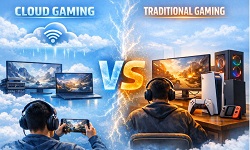
Cloud Gaming vs Traditional Gaming: Who Will Dominate the Future of Gaming?
The gaming industry is evolving at very high speed, from bulky gaming consoles and high-end PCs to playing games instantly through the internet, technology continues to redefine customer experience of the games.
Today, one of the biggest discussion on going is in the gaming world is Cloud Gaming vs Traditional Gaming. With impactful internet infrastructure and streaming technology improving every year, many wondering: Will cloud gaming replace traditional gaming, or will both coexist?
In this blog post, Let’s explore the strengths, weaknesses, and future potential of both approaches.
What is Traditional Gaming?
Traditional gaming refers to playing games on local hardware, such as PCs or consoles like the Sony PlayStation 5, Microsoft Xbox Series X, or Nintendo Switch. In this setup, the game is installed on the device, and the system’s GPU, CPU, and memory handle all the processing.
Key Advantages of Traditional Gaming
- High Performance and Graphics: Traditional gaming systems deliver top graphics and smooth gaming because the hardware processes everything locally
- Low Latency: As the game runs directly on the device, there is minimal delay between player input and on-screen action
- Offline Play: Many traditional games can be played without an internet connection
- Full Ownership: Gamers often own physical or digital copies of their games
Limitations
Traditional gaming has expensive hardware upgrades, large game downloads and storage requirements and having limited portability
What is Cloud Gaming?
Cloud gaming allows players to stream games from remote servers, similar to how movies are streamed online. The game runs on powerful data center hardware, and the video is streamed to the player’s device. Following are the popular cloud gaming platforms.
- NVIDIA GeForce NOW
- Xbox Cloud Gaming
- Amazon Luna
In cloud gaming, instead of buying expensive hardware, users only need a stable internet connection and a compatible device e.g. a smartphone, tablet, smart TV, or PC.
Key Advantages
- No Expensive Hardware Required: Cloud gaming removes the need for high-end GPUs or gaming consoles.
- Instant Access: Players can start gaming instantly without long downloads or installations.
- Play Anywhere – Portability: Games can be played across multiple devices including phones, tablets, laptops, and smart TVs.
- Auto Updates: Games are updated automatically on cloud servers.
Limitations
Cloud Gaming has limitations such as requirement of fast and stable internet, Having higher latency compared to local gaming, Potential subscription costs and also dependence on server availability.
Cloud Gaming vs Traditional Gaming: Key Differences
| Feature | Cloud Gaming | Traditional Gaming |
|---|---|---|
| Hardware | Minimal device needed | High-end PC or console |
| Performance | Depends on internet | Depends on hardware |
| Latency | Higher | Very low |
| Game Access | Streaming | Download/Physical |
| Portability | Very high | Limited |
| Cost | Subscription-based | Hardware + game purchases |
The Role of Future 5G and 6G Technologies
The evolution of technologies such as 5G and 6G networks will significantly influence cloud gaming. Faster speeds, ultra-low latency, and edge computing can make streaming games nearly comparable to local gameplay.
Companies like Microsoft, NVIDIA, and Amazon are heavily investing in cloud infrastructure, which shows strong industry confidence in the technology. So, the next question is, Who Will Dominate the Future? The most likely outcome is coexistence rather than replacement.
Traditional gaming will continue to dominate among hardcore gamers and esports professionals who demand the highest performance and lowest latency. Where as cloud gaming will expand rapidly among casual gamers and mobile users who prefer convenience and lower cost.
As internet speeds improve globally, cloud gaming will likely capture a larger share of the gaming market, but traditional gaming will remain important for high-performance gaming experiences.
Final Thoughts
Cloud gaming represents a major shift, how games are delivered and played, making gaming more accessible than ever. However, traditional gaming still offers unmatched performance and reliability.
Rather than competing, these two platform may complement each other giving gamers more flexibility and choice in how they play. The future of gaming may not be about choosing between cloud and traditional gaming, but combining the best of both worlds.